Study finds fiction ‘makes things happen’

auden“Poetry makes nothing happen”. It’s the most often quoted line of W.H. Auden’s famous elegy, “In Memory of W.B. Yeats” – it could even be the most quoted line of his career. People draw on it when they want to denigrate poetry: if one of last century’s great poets thinks poetry is more impotent than important, why should they have to read it?

But these readers tend to forget (or choose to ignore) what comes next: poetry survives, Auden asserts, “in the valley of its making”. It is “a way of happening”, he continues, “a mouth”. Auden was a realist and knew that poetry couldn’t stop the approaching machinery of war – the elegy was written in 1939 – nonetheless he upholds the human need to commune with other humans.

But might literature – novels, plays and, yes, even poetry – be more than a mouthpiece?

Literary aficionados and librarians have long argued the edifying effects of the literary arts, but until now they have been noticeably short on evidence. A recent study at Ohio State University, however, has confirmed that literature does in fact “make things happen”.

In the right situations, the researchers found, reading fiction can lead to measurable changes, if only temporary, in the lives of readers. In jargon that Auden no doubt would have choked on, the researchers coined the term “experience-taking” to describe the phenomenon in which readers feel a character’s emotions, thoughts and beliefs as their own.

“Experience-taking can be a powerful way to change our behaviour and thoughts in meaningful and beneficial ways,” said Lisa Libby, co-author of the study and assistant professor of psychology at Ohio State University.

In one experiment, 70 heterosexual male college students read a story about a day in the life of another student. There were three versions: in one the protagonist was revealed to be gay early in the narrative; in another the protagonist was identified as gay late in the narrative; and in a third the protagonist was identified as heterosexual.

Results showed that students who read the narrative in which the protagonist was identified as gay late in the story reported higher levels of experience-taking than those who read the narrative in which the protagonist’s homosexuality was announced early.

“If participants knew early on that the character was not like them – that he was gay – that prevented them from really experience-taking,” Libby said. “But if they learned late about the character’s homosexuality, they were just as likely to lose themselves in the character as were the people who read about a heterosexual student.”

Perhaps more importantly, the version of the story participants read affected how they thought about gays: those who read the gay-late narrative reported significantly more favourable attitudes toward homosexuals after reading the story than did readers of both the gay-early narrative and the heterosexual narrative.

Significantly, those who read the gay-late narrative also relied less on stereotypes of homosexuals – they rated the gay character as less feminine and less emotional than did the readers of the gay-early story.

Similar results were found when white students read about a black student who was identified as black early or late in the narrative.

Experience-taking is different from perspective-taking, where people try to empathise with another person’s experience – but without losing sight of their own identity. “Experience-taking is much more immersive”, Libby explains, “you’ve replaced yourself with the other”.

Interestingly, experience-taking only occurs when people are able to “forget” themselves – their self-concept and self-identity – while reading. In a fascinating experiment researchers found that most college students were unable to undergo experience-taking if they were reading in a cubicle that contained a mirror.

When people do undergo experience-taking, however, it can affect their behaviour for days afterwards.

In an experiment which took place several days before the last US presidential election, 82 undergraduates (who were registered and eligible to vote) read one of four versions of a short story about a student who overcomes a series of obstacles (car problems, rain, long lines) on Election Day before arriving at the booth to cast a vote.

After reading the story, the participants completed a questionnaire that measured their level of experience-taking. The results showed that participants who read a first-person narrative about a student at their own university had the highest level of experience-taking. And a full 65 percent of these participants later reported they voted on Election Day. In comparison, only 29 percent of the participants voted if they read the first-person narrative about a student from a different university.

But what are the practical applications of this research?

While the findings would seem to validate the librarian’s clarion call to get reading – for our higher good – other implications are not so heartening.

Might the findings, for example, be used to justify whitewashing, a disturbing practice in which publishers put white models on the covers of books featuring non-white protagonists?

In 2009 Australian author Justine Larbalestier was appalled to find her American publisher, Bloomsbury, had changed the cover model on her novel Liar from black to white in an effort to sell more books. Larbalestier was successful in her campaign to have her publisher to redo the cover, arguing that the perception that covers featuring non-white models do not sell is merely self-fulfilling prophecy. But what if a deeper psychology is at play?

And who is to say that a reader’s experience-taking of less virtuous characters is not an argument for censorship? Might the psychopathy of Patrick Bateman be contagious after all, as censors insist?

Recently fierce arguments have erupted in Germany over whether Hitler’s Mein Kampf has the power to make things happen. Some might argue that the diatribe is more fiction than fact, but this side of history, at least, it is hard to imagine anyone losing themselves in the character of Hitler.

Perhaps to be safe, though, it should be stipulated that the book only be read in cubicles containing a long mirror.

The Conversation

This article was originally published at The Conversation.
Read the original article.
Powers we pretend to understand: funder’s all that I am

Review of All that I Am by Anna Funder

“When Hitler came to power I was in the bath.” The sentence shocks with its indulgence – the bather’s husband is in the kitchen crushing limes for mojitos – as it conjures the vulnerability of naked flesh against the army of jackboots that are about to descend upon Europe. It also happens to be the first sentence of Anna Funder’s debut novel, All That I Am, which has had a busy time of late garnering literary awards and accolades. In addition to winning the Indie Book of the Year award, the Australian Book Industry Book of the Year, and the $35,000 Barbara Jefferis Award, it has been shortlisted for the $80,000 Prime Minister’s Literary Awards for fiction.

ImageGen.ashx“When Hitler came to power I was in the bath.” The sentence shocks with its indulgence – the bather’s husband is in the kitchen crushing limes for mojitos – as it conjures the vulnerability of naked flesh against the army of jackboots that are about to descend upon Europe.

It also happens to be the first sentence of Anna Funder’s debut novel, All That I Am, which has had a busy time of late garnering literary awards and accolades. In addition to winning the Indie Book of the Year award, the Australian Book Industry Book of the Year, and the $35,000 Barbara Jefferis Award, it has been shortlisted for the $80,000 Prime Minister’s Literary Awards for fiction.

All of which has fuelled speculation that All That I Am is a front-runner for this year’s Miles Franklin Award, which will be announced on Wednesday night in Brisbane.

Funder’s novel follows her impressive non-fiction title, Stasiland: Stories Behind the Berlin War, which presented first-hand accounts of life in the former German Democratic Republic. Whereas in Stasiland, Funder focused on post-war Germany, in All That I Am she has turned her attention to the decade preceding the war when Europe resolved – as left-wing German playwright Ernst Toller put it – “to hurl herself into the abyss of suicide”.

The narrative centres on a coterie of German dissidents – cousins, Ruth Becker and Dora Fabian, and their respective lovers, Hans Wesemann and Ernst Toller – whose political agitating against Hitler and his Third Reich necessitated their hasty departure from Germany and their subsequent resettlement in London as refugees.

The persecution the exiles suffer unfortunately doesn’t stop at the Channel, and their story builds to a harrowing – and tragic – denouement.

Funder came to the story through her friendship with Ruth Blatt, the novel’s dedicatee whose extraordinary life inspired the character of Ruth Becker.

Ruth – the sole survivor of the group – spent five years in solitary confinement in a German prison before securing her passage to Australia (via Shanghai) in 1947. She lived the next fifty years of her life alone in a flat in Bondi Junction. Funder has said:

In conversation, Ruth would move from criticising Hitler to criticising our own government at the time, in a way that made it clear that when you are living through something, there are some people who can see things for what they are (whether that’s dire, or just moderately unpalatable), and will always speak out. It is this kind of courage that fascinated me, along with the moral compass that underlies it.

All That I Am is a novel that questions the ubiquity of the human conscience, yet it insists on its cultivation. We ignore our conscience – or allow its distortion – at our peril. History shows that the consequences can be mighty.

As WH Auden (who makes a cameo appearance in Funder’s novel) writes in his poem, “In Memory of Ernst Toller”: 

We are lived by powers we pretend to understand:
They arrange our lives; it is they who direct us at the end
The enemy bullet, the sickness, or even our own hand.

It’s true All That I Am is a dark novel, but as history and a warning there aren’t many more important.

The Conversation

This article was originally published at The Conversation.
Read the original article.

you might also like

XX chromosomes returned to the Miles Franklin
Poetry takes down Günter Grass
Ondaatje: a lion at the cat’s table

XX chromosomes returned to the Miles Franklin

439628-anna-funderJust because it’s the debate we had to have, didn’t mean it wasn’t going to hurt.

The fracas began in 2011 when the Australia’s most prestigious literary award, the Miles Franklin, unveiled its all-male shortlist.

The gender imbalance might have gone unnoticed, if it hadn’t coincided with the latest VIDA research that revealed an alarming under-representation of female authors and critics in international literary pages.

Back in Australia, female authors were horrified to find VIDA’s inequities replicated in Australian publications. In sharp response, Sophie Cunningham and a handful of writers, publishers and commentators decided to do something about the lack of profile accorded female authors.

The result is a $50,000 literary prize for a book in any genre by a female Australian author: The Stella Prize. The eponymous award retrieves the given-name Miles Franklin believed she needed to suppress in order to be taken seriously as a writer.

Forwarding a year, Professor Gillian Whitlock announced, at the Mitchell Library in Sydney today, a very different Miles Franklin shortlist for 2012:

Speaking on behalf of the judging panel, Whitlock framed the shortlist in terms experience rather than gender: “The breadth of the shortlist includes well-known and loved Australian authors, as well as featuring two wonderful first-time novelists.”

She also highlighted the power of historical fiction (Funder and Moore) and an observable turn to trauma narratives and childhood (Birch, Mears and Parrett).

Debates on gender – along with the concurrent debate on the invisibility of Australian literature – are useful and will lead to greater understanding of our literary milieu. But it would be a travesty if these conversations were to throw doubt over the merits of the female authors shortlisted amid the uproar.

Frank Moorhouse is the heavy hitter on the list, but from what I hear the contest is still very much alive. The winner will be announced in a ceremony at the State Library of Queensland in Brisbane on 20 June.

The Conversation

This article was originally published at The Conversation.
Read the original article.

You might also like

Powers we pretend to understand: Anna Funder’s All that I Am
Poetry takes down Günter Grass
Carrie Tiffany wins a Stella Prize of her own
New Queensland literary award, no thanks to Newman


Poetry takes down Günter Grass

Günter Grass

The world of political poetry has suffered some significant losses in recent months. Václav Havel, a poet long before he was the last president of Czechoslovakia and the first president of the Czech Republic, died in late December 2011.

Although many of Havel’s poems were whimsical “concrete” poems, a good number were pointedly critical of Czechoslovakian society and politics of the time. These works, along with his other dissident activities, landed him in jail from 1979 until 1984.

February this year saw the death of the Polish poet and Nobel laureate, Wislawa Szymborska, whose poems chronicled Polish history from WWII, through Stalinism and beyond. “My poems are strictly not political. They are more about people and life,” Szymborska once remarked, “but, of course, life crosses politics.”

Feminists – and certain political regimes – have long believed that the personal can be very political indeed. It’s a message reiterated by Adrienne Rich, one of America’s most influential contemporary poets, whose poetry books have sold close to a million copies.

As a woman and a lesbian of Jewish descent, Rich was concerned with the politics of identity long before the idea became de rigueur. Poetry is a map, she declares in her poem, “Dreamwood”: not a revolution, “but a way of knowing / why it must come”. Rich’s death on 27 March dispatched a wave of mourning around the world.

The marriage between poetry and politics has a long history. Archilochus wrote some of the earliest political poetry, and Horace’s tribute to Augustus’s principate in the Roman Odes is among the greatest political poetry ever written.

While much of the earliest political poetry was written in tribute to leaders, much of contemporary political poetry is written in protest.

Robert Hass, American poet laureate (1995-97), elucidates the contemporary view: “I think the job of poetry, its political job, is to refresh the idea of justice, which is going dead in us all the time.”

Nevertheless, political poetry can be difficult for the critic to esteem. Harold Bloom held it to the highest measure in his attack on The Best American Poetry 1996 anthology, edited by Adrienne Rich, calling it “a stuffed owl of bad verse”. He was unable, he claimed, to find in it more than an authentic poem or two.

“It is of a badness not to be believed, because it follows the criteria now operative: what matters most are the race, gender, sexual orientation, ethnic origin, and political purpose of the would-be poet. Sincerity, as the divine Oscar Wilde assured us, is not nearly enough to generate a poem.”

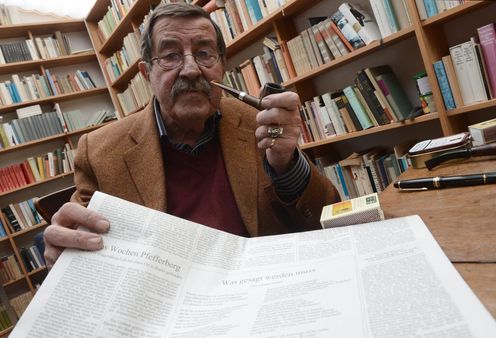
Yet sincerity is precisely the stuff of which Günter Grass’ incendiary poem, “What Must Be Said”, is made. The poem’s argument is two-fold. First, Israel’s nuclear arsenal is a threat to the Iranian people and “endangers an already fragile world peace”;

Second it argues why for a long time he has felt unable to voice his fears owing to a greater fear of being punished for the sins of his German forefathers:
But why have I kept silent till now?

Because I thought my own origins,
tarnished by a stain that can never be removed,
meant I could not expect Israel, a land
to which I am, and always will be, attached,
to accept this open declaration of the truth.

Despite his declared attachment to Israel, Grass was right to worry. The poem caused a tremendous ruckus when it appeared on 4 April in several European newspapers.

It demonstrated decisively that poetry can “make things happen” after all, on 8 April Israel declared Grass a persona non grata and denied him future entry into the country.

Israeli Prime Minister Benjamin Netanyahu said the poem’s allegation that Israel poses a greater threat to world security than Iran – “a regime which denies the Holocaust and calls for Israel’s destruction” – is a “shameful moral equivalence”.

Grass was quick to apologise for the wording in his poem: instead of saying Israel, he should have said “the Netanyahu government”.

Despite the brouhaha the poem has incited, most critics agree it isn’t particularly good. Heather Horn, who translated it from German, chided its “needlessly Teutonic constructions” and “winding and parenthetical tone”.

Someone once said publishing a poem is like throwing a feather off a cliff and waiting for the thud. In Grass’ case the feather turned out to be an elephant and he was standing under it.

The absurdity of fuss generated by an average-at-best poem would be amusing, were it not for the toll it appears to have taken on Grass’s health.

On Monday this week – two weeks after the poem’s publication – Grass was admitted with suspected heart problems to a hospital in Hamburg. “There’s no danger to his life,” his doctor said in a written statement, assuring the world that the 84 year-old poet would return home by “the end of the week at the latest.”

In some societies – past and, sadly, some present – poets pay with their lives for the gall of social critique.

Putting politics aside, let’s hope Günter Grass’s price will not be so costly.

The Conversation

This article was originally published at The Conversation.
Read the original article.