Australian poetry classics: Kenneth Slessor’s Five Bells gives Sydney Harbour back its darkness

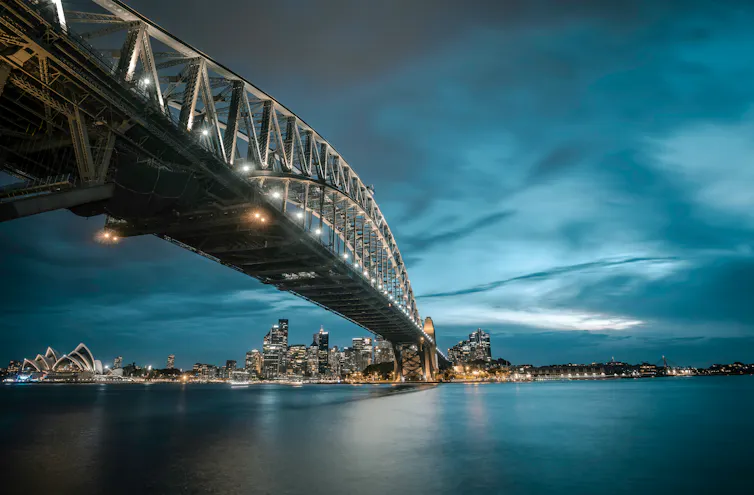
The Sydney Harbour Bridge seen from Milsons Point. Michael Amadeus/Unsplash

Bronwyn Lea, The University of Queensland

In our new series, we explore influential Australian poems.


Sydney Harbour is one of the most recognisable places in Australia. Today, it usually enters the imagination as spectacle: bridge, Opera House, ferries, fireworks, blue water, bright weather, moneyed views. It is a harbour endlessly reproduced: on postcards, in real-estate language, in tourist campaigns, and in the bright graphic shorthand of Ken Done.

Kenneth Slessor’s Five Bells gives the harbour back its darkness. His harbour belongs to an older Sydney: post-Bridge, pre-Opera House, still a place of wharves, ship-time and working water. This is the harbour before the white sails taught the world how to recognise the city.

Slessor is not writing the bright harbour of summer views. His Sydney is a working maritime city heard at night: bells across water, vessels in shadow, a warship below, light moving on the tide. Before the harbour becomes scenery, it is traffic, metal, labour and depth. Even the Southern Cross is caught in that dark reversal. In the poem, “the Cross hangs upside-down in water”.

Five Bells is an elegy for Slessor’s friend Joe Lynch, an artist and cartoonist, who drowned in Sydney Harbour in 1927 after falling from a ferry. Accounts of his death mention beer bottles in his overcoat pockets, a grimly ordinary detail that keeps the body in view before the poem turns him into water, weed and idea.

Slessor began the poem years later and worked on it slowly, completing it in January 1937. He published it in his 1939 collection Five Bells: XX Poems. This is not immediate lament, but grief after years of return. Memory, image, music and place circle the same loss.

Metropolitan unease

Kenneth Slessor was born in Orange, New South Wales, in 1901 and moved to Sydney with his family as a small child. The Sydney that entered his poetry was made of ships, newspapers, bars, advertisements, ferries, harbour light and metropolitan unease.

At a time when Australian poetry was still strongly attached to the bush, the ballad, rural labour and the heroic landscape, Slessor helped bring the modern city into the centre of its imaginative life. In his poems, Sydney glitters, ticks, rings, darkens and remembers.

Kenneth Slessor. National Library of Australia, via Trove

In Five Bells, all of that Sydney gathers in the harbour. The water measures time, reflects light, swallows a body and returns a voice only as echo. The harbour is not a backdrop to grief. It is the element grief moves through.

Slessor was a newspaperman: reporter, editor, critic, film writer, someone trained to notice cities in motion. His journalism shaped not only his subjects, but the poem’s method. Newspapers gave him the speed and clutter of modern Sydney; cinema gave him cuts, close-ups, dissolves and sudden changes of scale.

Five Bells carries that training in its flashes and shifts: from harbour to memory, from the struck bell to the drowned body, from panorama to close-up.

The flood that does not flow

The poem begins with a small, irritated image of time:

Time that is moved by little fidget wheels
Is not my time, the flood that does not flow.

From the start, Five Bells sets kinds of time against one another. There is clock time, moved by “little fidget wheels”: mechanical, measurable, almost contemptible. There is ship-time, sounded by bells across the harbour. And there is the speaker’s time, “the flood that does not flow”, where memory rises but does not pass.

Five bells gives the poem its audible measure, but grief breaks that measure open. The bells keep striking; Joe does not return. Perhaps the poem’s deepest strangeness lies there. Time is counted from outside, but suffered from within.

The harbour enters the poem through those bells. There is

            the double and the single bell
Of a ship’s hour …

There is

                                                a round of bells
From the dark warship riding there below.

In the old system of ship’s bells, time was sounded every half-hour through a four-hour watch; five bells means two and a half hours into that watch.

The poem hears those bells “coldly rung out in a machine’s voice”: mechanical, impersonal, unable to mourn. Later, Slessor calls five bells “the bumpkin calculus of Time”, a rough counting set against the poem’s deeper flood. But he makes that measure unstable. Joe appears inside it:

I have lived many lives, and this one life
Of Joe, long dead, who lives between five bells.

That word “between” is crucial. Joe does not live in a grave, a street, a suburb, or even safely in memory. He lives in an interval: after one sound and before another, in the struck space where time is measured but loss cannot be completed.

The friend under the tide

Five Bells gives Joe a life before it gives him to the water. Slessor remembers him as a friend, artist, talker and drinker. The two men knew each other in the newspaper world, first at Punch in Melbourne and then in the orbit of Smith’s Weekly in Sydney.

Memory returns Joe in broken, comic fragments: “a pot of beer”; “Milton, melons, girls and floating hair”. For a moment, Joe is not yet “part of an Idea”. He is alive in the tumble of talk.

But the poem also imagines Joe trying to answer. Slessor asks whether the dead man is “shouting” at him, pressing his face in “agonies of speech on speechless panes”. The image almost returns Joe to the world: face, mouth, the strain of words forming.

But nothing crosses. The image anticipates the final window scene, where the speaker stands in darkness, listening across the harbour. Again and again, the poem stages the same impossible relation: the living call; the dead cannot answer.

Then the poem asks its plainest question:

Where have you gone? The tide is over you,
The turn of midnight water’s over you,
As Time is over you, and mystery,
And memory, the flood that does not flow.

The question is answered first by water. The repeated “over you” presses down like depth itself: tide, midnight water, time, mystery, memory. Joe is not simply remembered. He is covered. Then Slessor makes the loss local:

You have no suburb, like those easier dead
In private berths of dissolution laid —

The “easier dead” have graves, addresses, “private berths of dissolution”. Joe has water. There is no plot, no headstone, no fixed place where grief can stand. The harbour holds him, but it cannot mark him. It keeps moving over him.

That is why the word “suburb” is so startlingly plain. It brings death back into the civic language of Sydney: address, district, belonging, a place where a life might be located. The “easier dead” have somewhere to be. Joe does not. He has not only lost his life. He has lost his place.

The passage then becomes beautiful and pitiless:

The tide goes over, the waves ride over you
And let their shadows down like shining hair,
But they are Water; and the sea-pinks bend
Like lilies in your teeth, but they are Weed …

The waves lower “shadows” like “shining hair”; the sea-pinks bend “like lilies” in Joe’s teeth. Then comes the correction: “they are Water”; “they are Weed”.

Slessor lets metaphor rise, then forces it back down into matter. The hair is water. The flowers are weed. The mouth is a drowned mouth.

The correction continues in the final phrase: “And you are only part of an Idea.” The hardest word is “only”. Joe has not become safely immortal in memory.

Abstraction is not rescue here; it is another form of loss. The living mind has turned him into thought because it cannot retrieve him as body.

Coldly ringing out

Five Bells returns to the harbour, but nothing has been resolved. The speaker is at the window, in the dark, still listening for Joe:

I looked out my window in the dark
At waves with diamond quills and combs of light
That arched their mackerel-backs and smacked the sand
In the moon’s drench, that straight enormous glaze,
And ships far off asleep, and Harbour-buoys
Tossing their fireballs wearily each to each,
And tried to hear your voice, but all I heard
Was a boat’s whistle, and the scraping squeal
Of seabirds’ voices far away, and bells,
Five bells. Five bells coldly ringing out.

The sentence keeps adding: waves and ships and buoys and whistle and seabirds and bells. Accumulation becomes another kind of deprivation. The harbour offers more and more of itself, but not the voice he wants.

Its beauty is part of its cruelty: “diamond quills”, “mackerel-backs”, tossed “fireballs”. Everything flashes and sounds. None of it becomes Joe.

This is what makes Five Bells such a severe elegy. The poem has been searching not simply for where Joe has gone. It has been asking whether anything can still reach him: memory, image, meaning, the repeated address of “you”.

The final scene refuses all of these as answers. The bells are not church bells. They offer no passage, judgement, resurrection or release. They measure time, and time keeps going. The harbour answers with whistle, seabirds and bells; it does not answer with Joe.

The afterlife of a poem

The poem’s afterlife has been unusually material. It has not only been read and remembered; it has been turned into sound, paint, public art and sculpture. Peter Sculthorpe’s piano composition Between Five Bells, later titled Harbour Dreaming, made the poem’s acoustic pull explicit. John Olsen returned to it twice: first in his 1963 painting Five Bells, and then in his vast Opera House mural Salute to Five Bells, a nocturnal underwater vision of Sydney designed to be viewed after dark.

There is a stranger form of return in the sculpture Satyr, modelled partly on Joe and created by his brother Guy Lynch, which sits in Sydney’s Royal Botanic Gardens near the Opera House gate, looking out towards the water where Joe drowned.
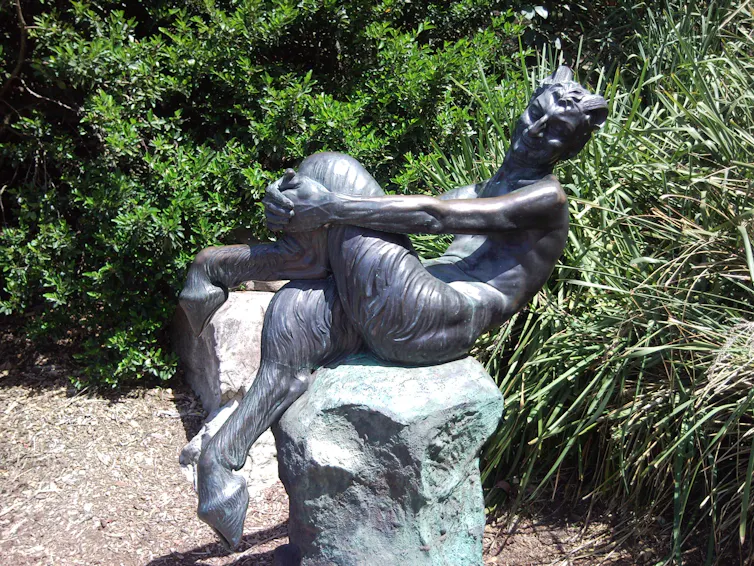
Satyr – Guy Lynch, Royal Botanical Gardens, Sydney. MD111, via Wikimedia Commons, CC BY-SA

In 2008, ABC listeners voted Five Bells Australia’s favourite poem: a striking fate for a poem so austere and unresolved.

Slessor died in 1971. By then, he had written relatively little poetry for three decades, but his place in Australian literature was secure. Five Bells and Beach Burial remain the poems most closely attached to his name. One is an elegy for a drowned friend; the other is a wartime elegy for the anonymous dead.

But his achievement is larger than those two elegies. In poems such as Five Visions of Captain Cook, William Street, Out of Time and South Country, he helped change what Australian poetry could notice, and how sharply it could notice it: city light, historical violence, cinema, journalism, and the broken rhythms of modern life.

Five Bells keeps Joe close without returning him. He is listened for, looked for, spoken to, never found. Slessor leaves us at the window, in the dark, listening. The water is bright. The birds scrape the distance. The bells ring coldly. Joe is still gone.

Bronwyn Lea, Professor in Australian Literature and Writing, The University of Queensland

This article is republished from The Conversation under a Creative Commons license. Read the original article.

Bronwyn Lea reviews Collected Poems by Les Murray

IMAGE-Les Murray Collected Poems Bronwyn Lea
Sprawl, as defined in the classic Les Murray poem, is ‘the quality of the man who cut down his Rolls-Royce / into a farm utility truck’. Sprawl is also ‘doing your farming by aeroplane’ or ‘driving a hitchhiker that extra hundred miles home’.

Murray says he learned the term from his father who used it to describe ‘a kind of shirtsleeve nobility of gesture. Not pinched-arse Puritan at all’. Rather sprawl is ‘loose-limbed in its mind’. It assumes an easy surplus – ‘the fifteenth to twenty-first / lines in a sonnet’ – and runs no tabs. Never ostentatious it has no truck with ‘lighting cigars with ten-dollar notes’ or ‘running shoes worn / with mink and a nose ring’.

Sprawl, broadly speaking, is rural largesse: ‘an image of my country’, he says, ‘and would that it were more so’.

‘The Quality of Sprawl’ moonlights as a praise poem to rural Australia’s yawning landscapes and its inhabitants with a genius for making do. But its real job is to throw shade at the urban elite who, mentally cramped from years of vertical living, would see sprawl expelled from the Earth. Sprawl grins with ‘one boot up on the rail / of possibility’ and thinks that unlikely.

But Murray – a self-taught polyglot who famously plays at subhuman redneck – is not so sure. Sprawl is antithetical to political correctness, and Murray has the battle scars to prove it. The poem ends: ‘People have been shot for sprawl.’

Les Murray was born in the small town of Naiac – north west of Forster and south of Taree – on 17 October 1938. The dropping of his latest Collected Poems – a handsome and weighty hardback bearing Murray’s trademark visage on the cover – is timed to commemorate the eightieth birthday of Australia’s most famous living poet.

I say ‘latest’ because, in good sprawl spirit, Murray’s been rolling out stockpiles of ‘all the poems he wants to preserve’ since 1991. Nevertheless Les Murray: Collected Poems soars above earlier remits. In compiling 15 books across a remarkable 50-year span – four from this century and 11 from the last –.it is his closest approximation yet to a lifetime of poetry.

But Collected Poems is more a sprawling selected – and, yes, he’s had six of those – than a genuine collected. Rather than reproducing each book as it appeared in print, Murray takes the axe most brutally to his early books but hacks small holes in the later ones as well.

Sometimes it’s not clear why a particular poem has been disowned – ‘Self and Dream Self’ from Waiting for the Past seems to me, as it must have to the editors at Poetry magazine who first published it, a perfectly good poem.

Other exclusions, under scrutiny, are forgivable and, in the rare instance, commendable: ‘The Abortion Scene’; or ‘The Massacre’, which empathises with the gunmen not the victims of an American high-school shooting. Both poems, however, survive online.

The irony of choosing the book as his preferred technology for the preservation of his poems is likely lost on Murray. In ‘The Privacy of Typewriters’ he describes himself as ‘an old book / troglodyte’ who ‘composes on paper’ and ‘types up the result’ on a typewriter – or he did, at least until it became impossible to buy new typewriter ribbons. Computers scare him, he says in the poem, not just for their ‘crashes and codes’ and ‘text that looks pre-published’ but also for that one ‘baleful misstruck key’ that could land him on a child pornography site and soon after in handcuffs.

Yet Murray’s digital presence is large. The Australian Poetry Library houses all the poems from his books up to 2006, and his eponymous website, run by enthusiast Jason Clapham, archives for posterity the very poems Murray claims to disown. Given Murray’s site gets more unique visitors in a month than he might expect readers for an entire print run, books seem headed the way of typewriter ribbons.

As a physical object Collected Poems is a colossal and immensely readable corpus that shows us what Murray sees looking back from eighty on a life built out of ink and paper. He has been thinking about his body of work, and constructions of his textual body, for a long time. As far back as ‘Evening Alone at Bunyah’ he told his father, ‘I only dance / on bits of paper’.

In his 1997 essay ‘Poemes and the Mystery of Embodiment’, Murray tenders an idea that ‘everything we make, especially if it is with passion, is a new body for ourselves’. He discloses the secret to canonical longevity:

‘We create our body of work, our corpus operarum, a very ancient metaphor, and we try to load every rift with awe, since that is the only fuel which can power its journey into future time’.

Murray’s first book of poetry, The Ilex Tree, appeared in 1965 as a joint publication with Geoffrey Lehmann. A mere eight of Murray’s 25-poem contribution find refuge in the Collected, but those that do are as potent as anything he’s written since. The early poems are more measured than the later ones, but the eye for spectacle and genius for weird metaphor are unmistakably Murray.

‘The Burning Truck’ launches the Murray oeuvre with a shattering of crockery as fighter planes, coming in from the sea, set a town on fire. A ghostly truck – its ‘canopy-frame a cage / torn by gorillas of flame’ – is hurled driverless through the town, growing enormous, then disappearing out of the world.

Although Murray discards more than half the contents of his first sole-authored collection, The Weatherboard Cathedral introduced his most famous poem: ‘An Absolutely Ordinary Rainbow’. Atypically, it’s set in a city: ‘There’s a fellow crying in Martin Place’, the poem announces, ‘They can’t stop him’. The man gives full expression to his sorrow – ‘hard as the earth, sheer, present as the sea’ – then mops ‘his face with the dignity of one / man who has wept’ and hurries down Pitt Street.

Murray would go on to publish an average of three books a decade until the end of the century, each yielding handfuls of great poems that catapulted Murray’s name into Laureate circles. Among them: ‘Walking to the Cattle Place’ from Poems Against Economics (1972); ‘The Broadbean Sermon’ from Lunch and Counter Lunch (1974); ‘The Buladelah-Taree Holiday Song Cycle’ from Ethnic Radio (1977); ‘Equanimity’ from The People’s Other World (1983); ‘The Dream of Wearing Shorts Forever’ from The Daylight Moon (1987); the eponymous poem from Dog Fox Field (1990); and the ‘Presence’ suite from Translations from the Natural World.

But Murray’s millennial collection, Subhuman Redneck Poems – which earned him the TS Eliot Prize for Poetry and reprimands from his old foe, the urban elite – remains the standout. Long before Hilary uttered her career-ending phrase, Murray knew he’d been consigned to the Basket of Deplorables: he’s been trying to write his way out of it for the last half century.

Rereading these poems now, as they retreat deeper into history, a certain prescience can be glimpsed. Long before the Treasurer caved to cries for a Royal Commission, Murray was railing against the banks. ‘The Rollover’ inverts the social hierarchy to put bankers at the mercy of farmers: ‘Some of us primary producers, us farmers and authors’, it begins, ‘are going round to watch them evict a banker’.

‘Who buys the Legend of the Bank anymore?’ the farmer asks. ‘It’s all an Owned Boys story’. It ends: ‘No land rights for bankers.’

Similarly Murray’s poems took seriously the trauma of childhood bullying long before it was dinner-table conversation. Early critics found his reports of bullying inadequate to the scale of his resultant depression, but readers on closer terms with rejection were more sympathetic. ‘Burning Want’ ­– which today might serve as a key text for the incel movement – describes Murray’s sexual shaming at the hands of high-school girls as ‘erocide’ – the destruction of his sexual morale – which produced in him, he says, ‘a buried fury of sex and a terror of women’.

Murray’s four books of this century – Poems the Size of Photographs (2002), Biplane Houses (2006), Taller When Prone (2010) and Waiting for History (2015) – continue his display of linguistic dexterity but work to a smaller canvas. Herein his poetic impulse angles away from public argument toward an ethnographic project to memorialise the vanishing objects of his rural childhood.

Murray has a long history of diagnosing illnesses in poems: his depression, his son’s Autism and his own, the virulent liver infection that left him in a three-week coma in 1996. As he approached his eighth decade, hospital visits, nursing homes, and his own physical frailty arrived as new subjects for poems.

Waiting for the Past opened a new era of vulnerability: in ‘Diabetica’ a man ‘yawns upright / trying not to dot the floor / with little advance pees’; while in ‘Vertigo’ a man falls in a hotel bathroom and finds his ‘head in the wardrobe’. As stumbles increase in frequency – any time after sixty or before – it’s ‘time to call the purveyor / of steel pipe and indoor railings’, he says. The poem gestures toward a twilight that awaits us all:

Later comes the sunny day when
street detail gets whitened to mauve
and people hurry you, or wait, quiet.

In ‘The Last Hellos’, Murray recalls his father’s final year: ‘Don’t die, Dad’ – the refrain goes – ‘but they do’. It ends with a son wishing his father God. My closing echoes the final stanza and repurposes it as a commendation: Snobs mind us off Murray / nowadays, if they can. / Fuck thém, I wish you Murray.

This article was first published in The Australian as ‘Les Murray’s Collected Is Really a Sprawling Selected‘ (17-18 Nov 2018)

Australian Poetry Now

Once asked what poets can do for Australia, A.D. Hope replied: “They can justify its existence.” Such has been the charge of Australian poets, from Hope himself to Kenneth Slessor, Judith Wright to Les Murray, Anthony Lawrence to Judith Beveridge: to articulate the Australian experience so that it might live in the imagination of its people. While the presence and potency of the Australian landscape remains an abiding interest, a great deal of Australian poetry has been innovative and experimental, with poets such as Robert Adamson, Michael Dransfield, Vicki Viidikas, John Forbes, Gig Ryan,   J.S. Harry, and Jennifer Maiden leading the way. The richness, strength, and vitality of Australian poetry is marked by a prodigious diversity that makes it as exhilarating to survey as it is challenging to encapsulate.

While the most convincing justification for the existence of Australia might come from its indigenous poets, Aboriginal poetry in Australia has been particularly overlooked, both its historical traditions and the innovative work being written today. >>Read more at Poetry Foundation

A gift adrift: what the loss of RN’s Poetica means to poets

Australia’s long-running literary flagship program – Poetica on Radio National (RN) – is slated for axing in 2015. It’s one more casualty of the cuts to the ABC budget, announced last week.

For the first time since 1946, ABC Radio will be without a dedicated poetry program.

Barry Hill, a poet and radio critic for The Age from 1978 to 1990, placed the blame not with the Government but squarely on the broadcaster’s shoulders: “Shamelessly,” he wrote in The Age, “the Australian Broadcasting Corporation beheaded poetry”.

Hill points beyond the budget to what he sees as the “mega culprits”. These include the ABC’s “managerial corporate ethos” and its “insipid grasp of what might be called a critical culture”.

Even if true, it hasn’t always been the case.

Poetry has had a safe home on radio since the ABC’s inception on July 1 1932 – as Mike Ladd details in his 75th anniversary of ABC Radio – when the bells of Sydney’s General Post Office first were broadcast to the nation.

Prime Minister Joseph Lyons issued the station with a charter to “provide information and entertainment, culture and gaiety” while serving “all sections and to satisfy the diversified tastes of the public”.

Early on, as Ladd recounts, poetry appeared on ABC radio in the form of (usually Shakespearean) dramas. Douglas Stewart was the first Australian author to have his verse dramas broadcast – beginning with The Fire on the Snow in 1941 and Ned Kelly in 1942 – followed by Colin Thiele, Rosemary Dobson and others.

In 1946 John Thompson – poet, editor and moreover the father of actor Jack Thompson – founded Australia’s first weekly program dedicated to poetry. Quality Street ran for an impressive 27 years before being replaced by Sunday Night Radio 2 in 1973.

Founded by Richard Connelly, Julie Anne Ford, and Rodney Wetherell, Sunday Night Radio 2 ran regular, full-length features on poetry, as did its 1981 successor, Radio Helicon, whose executive producer was at one time the poet John Tranter.

Another long-running program, The Poet’s Tongue, appeared in 1957 and ran until 1986. In the early days the producers drew on actors, Judy Davis among them, to perform the poems. Soon the program employed the more contemporary idea of featuring the poets themselves to read and discuss their work.

In 1986 the Poet’s Tongue was replaced by Richard Buckham’s The Poetry Feature, a 30-minute segment slotted into the Sunday Fictions, which ran until 1994. After a brief poetry-free stint following the axing of Sunday Fictions, a program called Box Seat ran for a couple of years before morphing into Poetica in 1997.

Airing every Saturday afternoon since 1997, Poetica has produced more than 900 programs, 60% of which have featured Australian poets. At its peak it reached 90,000 listeners per week. According to some sources it currently attracts as many as 60,000 listeners per week, with more on the internet.

Produced by Mike Ladd, Poetica draws on live readings, studio-based poetry features and on-location recordings. It is admired in the English-speaking world for the way it presents poetry, embedded in rich soundscapes, carefully crafted to enhance comprehension and heighten the listener’s experience of the poem.

Not only has Poetica brought poetry to a broad audience, it has also amassed a free online archive from which past programs can be downloaded by researchers and the general public. And not to be overstated, it has provided much-needed exposure for poetry publishers and a source of income for poets in the form of copyright fees.

A freelance radio producer, Prithvi Varatharajan, described the axing of Poetica to me as “a huge loss to Australian audiences”. He elaborates:

George Orwell, in his essay Poetry and the Microphone, spoke about the ‘possibilities of the radio as a means of popularising poetry’. Poetica was doing just this in Australia, and the overwhelming majority of online feedback shows just how appreciative audiences have been of the program. We can only hope that there is some room for poetry on the ABC in the future, after Poetica is gone.

It has been suggested that RN will replace Poetica – along with its axed cousins, Bush Telegraph, Into the Music, Hindsight and 360 Documentaries – with a multi-purpose, weekday feature-slot that will run commissioned 28-minute radio documentaries from freelance producers.

Certainly a new program offers consolation, but in its contraction of scope and expertise the successor looks to be far from commensurate with the cultural gift that was Poetica.The Conversation

*

This article is republished from The Conversation under a Creative Commons license. Read the original article.

Bronwyn Lea reviews The Doll’s House directed by Lally Katz

When Jane Caro compared traditional marriage to prostitution on a recent episode of Q&A, she did not mean to conflate today’s stay-at-home mothers with sex workers.

But that didn’t stop the loud handful who had missed (or ignored) the historical frame from airing their consternation at Caro’s perceived denigration of “housewives” as “whores”.

Clearly those who objected to the idea that marriage has a long history as an economic institution in which women have traded sex for resources have never read Jane Austen’s Pride and Prejudice. Or if they have they have failed to grasp its central tenet.

It’s also a safe bet that they haven’t thought much about Henrik Ibsen’s 19th-century masterpiece A Doll’s House, which outraged audiences when it premiered at the Royal Theatre in Copenhagen in 1879 for its daring critique of the “holy covenant” of marriage.

Ibsen’s inspiration for the play came from the real-life story of a good friend, Laura Kieler, whose husband committed her to an asylum after she forged a bank cheque in a secret effort to fund a cure for his tuberculosis.

Ibsen was incensed by the injustice: “A woman cannot be herself in modern society”, he said in Notes for a Modern Tragedy, “with laws made by men and with prosecutors and judges who assess feminine conduct from a masculine standpoint”.

In an outrageous and surprisingly hilarious new version of A Doll’s House currently playing at the Brisbane Festival, dramatist Lally Katz injects Ibsen’s play with techno music and stuffs it with popular culture references to everything from menopause to internet porn.

Staged in La Boite’s Roundhouse Theatre, Dan Potra’s fabulous set is a giant chess board built of packing crates, overhung by netting that serves as a metaphor for the “tangled web we weave / when first we practice to deceive”. Director Steven Mitchell Wright has the actors traverse the stage at eerie parallels, each condemned to a life without connection. Blinded by secrets and lies, their gaze can never meet.

Helen Christinson is marvellous as the infantilised Nora – think Material Girl meets Effie Trinket – whose fashion sense derives in a straight line from the pink macaroons on which she furiously binges (in private).

Hugh Parker plays Torvald Helmer, Nora’s banker-husband with a cringe-worthy penchant for zoomorphizing his wife – not as a squirrel (hoarder of lies, secrets, money) as in Ibsen’s original, but as an effervescent hummingbird put on this earth for his sole delight:

“It tickles me when you get excited, Nora,” Torvald says in high praise of her vapid-enchantress act.

Nora signals her transformation into a Modern Woman in the final act by stripping off her Like a Virgin-inspired costume – white lace, black gloves, crucifix, etcetera – to reveal her inner Pretty Woman, which in this case is clad in a slinky black dress and cerulean blue ankle-boots.

Of course it’s entirely possible Nora’s little number (replete with sexy cutouts) is not intentionally suggestive of a Working Girl at all, but rather a self-possessed Working Woman in contemporary office attire – but to dissect the difference here would be to construct a battlefield I’m not about to die on.

Nora’s striptease is accompanied by a sermon of predigested ideas – something along the lines of Charlene’s “I’ve been to paradise, but I’ve never been to me” – delivered with such sincerity that it’s a teeny bit of a relief (for the wrong reasons) when Nora finally walks out on her marriage and her children.

A harder hitting ending would have had some of the grunt and fire of Julia Gillard’s famous misogyny speech which showed that, more than a century on, Ibsen’s slamming door can still reverberate around the world.


A Doll’s House plays at the Brisbane Festival until 27 September 2014

This article is republished from The Conversation under a Creative Commons license. Read the original article.
Escape artist

Maria Takolander Reviews The Deep North: A Selection of Poems (with a note by Paul Kane) (New York: George Braziller, 2013) by Bronwyn Lea. This review appeared in Cordite.org.au
(20 December 2013).

by maria takolander

The Deep North: A Selection of Poems by Bronwyn Lea (with a note by Paul Kane). New York: George Braziller, 2013.

It is a tribute to the quality and readability of Bronwyn Lea’s poetry that a selection of her work forms the second volume in the new George Braziller series (edited by Paul Kane), which aims to introduce contemporary Australian poets to American readers. True to lyric poetry, Lea’s poems are musical in their composition, and they can be intimate in their subject matter. However, Lea’s work is never just about crafting agreeable verse, and it is never just about her personal experience. What makes Lea’s poetry so striking and meaningful is its acknowledgement of a wider and worldly context: historical, geographical, biological, political. In fact, Lea’s poetry might be said to enact an ironic rejection of the claustrophobic potential of autobiographical verse by continually fleeing from it to something else. This might be typical of contemporary post-Romantic poetry generally, though in Lea’s poetry—highlighting the importance of gender to the work—that flight is often symbolised by the rejection of the trappings of romantic love for a liberating movement into ‘a vantage point … a vista’ (as we read in ‘Driving into Distance’). This makes Lea’s work reminiscent of Emily Dickinson’s restless verse, with Dickinson’s presence apparent in the exquisite poem ‘Insufficient Knowledge.’  Continue reading

Foreword: australian poetry journal 3.2 #concrete

Screen Shot 2014-03-18 at 10.05.39 amIn everyday scale, a letter of the alphabet is usually no bigger than a freckle or an iris, and a word is not much wider than a thumbnail. The tiny components of written language are rendered almost invisible to us in our race to extract all-important ‘meaning’. But in concrete poetry, language stands in our way: letters and words fight – through scale or arrangement – for visibility. As Roberto Simanowski puts it: ‘concrete poetry deals with the relation between the visible form and the intellectual substance of words’. It is visual, he says, because it ‘adds the optical gesture of the word to its semantic meaning’. As a consequence, concrete poems ask readers to look simultaneously ‘at’ and ‘through’ language.

Some poems make a performance of typography. John Warwicker’s design for ‘In the Belly of Saint Paul’ – replete with stylish ornaments, discretionary ligatures and mimetic kerning – would seem to validate psychologist Kevin Larson’s 2006 finding that an aesthetic typeface can elevate our mood (it can also increase creativity and cognitive focus for a period after viewing). Jordanian calligraphic artist Ibrahim Abu Touq depicts a poem by 12th century Sufi mystic Ibn Arabi; while the late Cornelis Vleeskens (whose work has rarely appeared in editions greater than a handful) appears to reference Japanese calligraphy, though the spill of Roman letters doesn’t quite add up to a word. Extracted from his series of concrete anagrams, Christian Bök’s ‘Odalisque 02’ employs the 21 components of letterforms – serifs, spurs, ascenders and so on – as brushstrokes to evoke the female figure within a fractured alphabet; while Ken Kempson’s ‘Saint Poet Quoted’ uses the single inverted-comma to illustrate a field of infinite quotation.

Chris Edwards, Toby Fitch and Pascalle Burton reveal that quotation is frequently the stuff of concrete poems. Edwards’s After Naptime, an extract from a 12-scene ante-narrative about a trip to a haunted lighthouse, retains traces of Dickens’s David Copperfield and Bleak House and Dennis Cooper’s ‘The Anal-Retentive Line Editor’ and snips images from Ward, Lock & Co.’s Great Inventors and Lawrence Lessing’s DNA: At the Core of Life Itself. Fitch’s ‘Missing Scène(s)’ presents as a redacted poem but is, the author says, a mistranslated inversion of Rimbaud’s ‘Scènes’. In contrast, Burton’s poème trouvé makes no mystery of its source: the physical object of H.G. Wells’s The First Men in the Moon.

Not surprisingly several of the poets here are also practitioners in the visual and plastic arts. The original artwork for Angela Gardner’s ‘A Quiet Voice’ is a watercolour on Chinese concertina-folded paper, and Nancy Campbell’s ‘How to Say I Love You in Greenlandic’ is made from hand-printed pochoir and letterpress. Campbell’s full sequence comprises 12 words: one for each letter of the Greenlandic alphabet, although here we present only six. (In case you are wondering, ‘asavakkit’ is how Greenlanders declare their love.) Visual poems by pete spence and Eryk Wenziak explore a zone of indeterminacy but retain an affiliation with language that prevents their work from stepping over into objects. Elsewhere Cecilia White and John Selenitsch eschew ink and paper to sculpt poems out of marble, wood and Perspex for the gallery floor.

In criticism, π.o. shines the spotlight on legendary performance-poet Jas H. Duke – a big-boned fan of rounded sound, who reportedly once ate a page of Yeats while reciting a poem, and whom π.o. says is Australia’s only Dadaist poet of any note. Alison Clifton looks at recent poetry collections to flirt with text and image: Marionette: A Biography of Miss Marion Davies, Jessica Wilkinson’s biography of silver-screen siren Marion Davies, and Fitch’s Rawshock, accompanied by homonymic Rorschach inkblots. Selenitsch gives a fascinating run-down of the development of concrete poetry from an Antipodean perspective and identifies Alan Riddell – Townsville-born poet and editor of the classic anthology Typewriter Art – as a precursor to the art form in Australia. To accompany his essay we offer a selection of classic Australian concrete poems, courtesy of the 2013 Born to Concrete exhibition (which inspired this special issue) curated by the Heide Museum of Modern Art and University of Queensland Art Museum. In ‘Heartheart’ poet and installation artist Richard Tipping contributes an essay that chronicles his 40-year fascination with circle poems and poem squares, while Martin Duwell rounds out the issue with a look at Clive James’s new translation of Dante, paying his respects to the Inferno’s resplendent architecture and dramatic portraits and noting that the sign above the Gates of Hell has been changed.

Order

Booker-Prize-winner Eleanor Catton and male critics aging badly

73.Eleanor Catton-The LuminariesYou could forgive a reader for thinking that journalists were writing about 16 year-old Lorde who topped the US charts last week with her song Royals, not a 28-year-old writer who already has an award-winning book under her belt, as well as a degree in English from the University of Canterbury, a Masters from Victoria University’s Institute of Modern Letters, and an MFA from the prestigious Iowa Writers Workshop.

That’s the extent to which journalists around the world made a fuss of Eleanor Catton’s “tender age” – which anyone reading the book pages must know by now is 28 (I can even quote her birthday without Googling: 24 September, which makes her a Libran) – when her 832-page novel, The Luminaries, won the 2013 Man Booker Prize.

Until Catton displaced him, Ben Okri held the record for youngest Booker winner when he won for The Famished Road (1991) at age 32. Before him it was Kazuo Ishiguro and Salman Rushdie, who were both 34 at the time of their respective wins for Remains of the Day (1989) and Midnight’s Children (1981).

Yet not one of these authors were framed by their youth. Nor were they described as looking “remarkably self-possessed”, as Nick Clark kindly but nonetheless patronizingly described Catton’s demeanor “the morning after the night that changed her life.”

There are a number of reasons why Catton’s age might have become the headline: the Booker is Britain’s most prestigious literary prize and to win at all is a colossal achievement. And she did break the decade barrier. The profiles of Booker Prize winners shows that most of them have their first success at around 30, peak in their 40s, then die twenty-odd years later.

Historically, some literary giants are late bloomers, yet many others burn bright from an early age. Alexander Pope wrote his much-anthologised “Ode on Solitude” when he was 12 and published The Rape of the Lock (1712) when he was 24. By 24 Shakespeare had written Henry VI (1591).

By age 20 Jane Austen had written Sense and Sensibility, Mary Shelley had written Frankenstein – both books were published a few years later in 1811 and 1818 respectively – and Rimbaud had retired from writing.

Goethe published The Sorrows of Young Werther (1786) when he was 25 and Emily Brontë published Wuthering Heights (1847) when she was 28 – by that age John Keates was already three-years buried.

Hemingway published The Sun Also Rises (1926) at age 27, but F. Scott Fitzgerald didn’t publish The Great Gatsby (1925) until he was 29 – in fairness he already had published two books before he composed his Jazz Age classic. Likewise Bret Easton Ellis published two novels before American Psycho (1991) appeared when he was 27.

But authorial precocity is not quarantined to centuries past: Zadie Smith published White Teeth (2000) when she was 25 – the same age Jonathan Safran Foer was when Everything Is Illuminated (2002) came out.

Of course none of these writers won the Booker: it didn’t exist until 1969; and American authors, until last month, have been barred from entering.

Though The Luminaries was generally well-received in Britain, Catton said in an interview in the Guardian that it was “subject to a ‘bullying’ reception from certain male reviewers of an older generation – particularly in New Zealand.”

“People whose negative reaction has been most vehement have all been men over about 45,” she says.

London-based, New Zealand author and critic CK Stead got stuck on what he called the novel’s “chintzy upholstered tone”. He also became an antagonist in a particularly apoplectic review by Michael Morrissey, a 71-year old novelist and poet from Auckland, who writes:

“Eleanor Catton, it seems, can do no wrong, but is she doing anything right – apart from selling well?”

Catton’s first novel, The Rehearsal, so Morrissey informs us, was “written when the author was virtually a child of 21 (or so)” and “set a new hallmark in schoolgirlish bitchiness, as well as including flashes of purple writing – understandable in one so young. Femmes were impressed; chaps less so.”

The Rehearsal, Morrissey concedes – published in 17 territories and 12 languages – was “an impressive achievement for one barely out of school uniform.”

But before he can find his way to the text, Morrissey has more to say about Catton’s person: “The pensive-featured, marginally beautiful Ms Catton was made an adjunct professor at Iowa University.”

[At this point in the review, I scrolled to the masthead to see if I had stumbled onto The Onion or some other satirical site.]

He also offered Catton some grandfatherly advice, inside which is a wonderfully wrong prediction: “she must not let potential Man Booker (which will probably go to Jhumpa Lahiri) go to her thought-crowded head.”

O, these damned scribbling women!

At least Nicholas Lezard had the grace to wrap his envy in humour: “Failure is good for the soul,” he writes. “At least that’s what I tell myself as I contemplate the successful young.”

But Catton has better things to do than to contemplate the not-as-successful-as-they’d-like-to-be old.

“One of those things that you learn in school about any kind of bullying is that it’s always more to do with them than it is to do with you,” she says. “I don’t see that my age has anything to do with what is between the covers of my book, any more than the fact that I am right-handed. It’s a fact of my biography, but it’s uninteresting.”

Eleanor Catton has already sold the rights to The Luminaries, which she hopes will become a boxed set television show, rather than film. If she succeeds, which I’m betting she will, it will be a bucket of water in the face for “select male reviewers over 45”.

“I’m melting,” they will cry as they fall in a puddle, but no one will be listening.

Bronwyn Lea does not work for, consult to, own shares in or receive funding from any company or organisation that would benefit from this article, and has no relevant affiliations.

The Conversation

This article was originally published at The Conversation.
Read the original article.

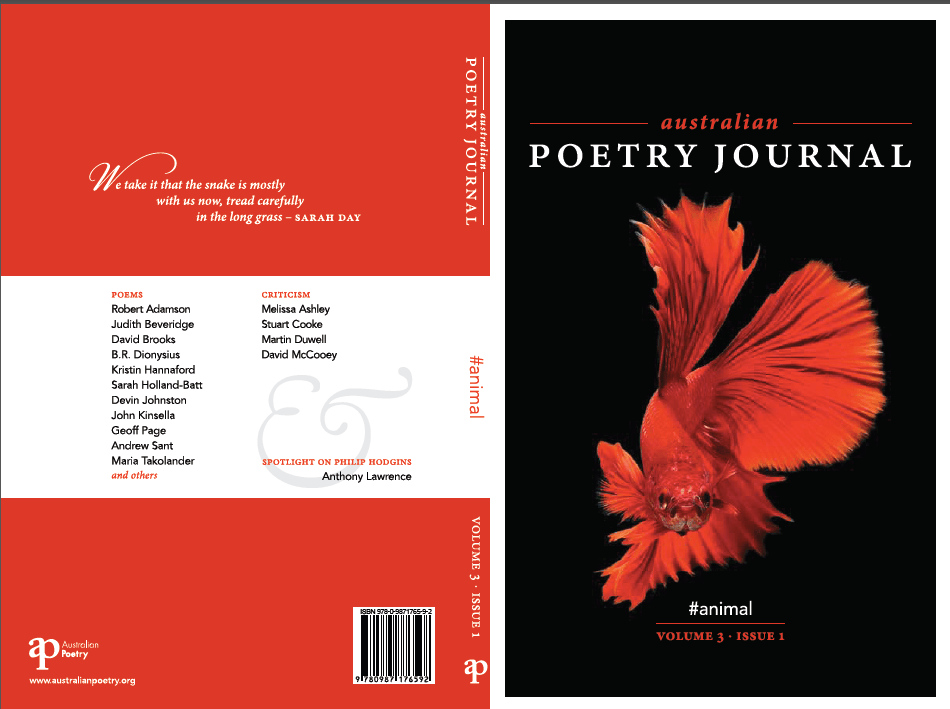
Foreword: australian poetry journal 3.1 #animal

Screen shot 2013-09-02 at 8.32.21 AMHumans may prefer to distinguish themselves from all other multiccellular, eukaryotic organisms but ‘humans’ live only in the philosopher’s imagination. In the minds of biologists we are Homo sapiens of Kingdom Animalia. Questions of nomenclature notwithstanding, the human relationship to animals is under the microscope in the #animal issue of Australian Poetry Journal.

In addition to the myriad roles animals perform in human societies – as companions and workers, as food and objects of sacrifice – animals serve in the human imagination as harbingers of traits we aspire to achieve: football teams, as John Kinsella points out in his poem ‘Zoo’, are called ‘The Falcons, The Eagles, The Seagulls, The Tigers, The Lions, The Kangaroos’. In Judith Beveridge’s poem, ‘Back in the Monastery’, a speaker prays to the dark goddesses, Elephant-Face and Lion-Face, who sit at the threshold of time; and in Ron Pretty’s poem on Marco Polo’s first encounter with a unicorn – ‘or so / he called’ the rhinoceros – ‘myth segues into armour-plated gut’.

Horses run through many poems: sometimes as machinery – ‘a workhorse in a dark field’ in Todd Turner’s ‘Bonsai Wattle’ – or as instruments of war. Waterborne horses are ‘backed against bad weather’ in Angela Gardner’s ‘Ilium’ and horseborne Carbineers ride through Geoff Page’s ‘Marginalia’. But who’d have guessed that goats would dominate a selection of contemporary poems? Among various appearances, mountain goats climb cemented rocks to look down ‘on over-excited human children with disdain’ – again, Kinsella’s poem – and in Kristin Hannaford’s ‘Elegy for Lost Goats’ a nineteenth-century Inspector of Nuisances slits the throats of 400 feral goats to use as fertiliser in the Rockhampton Botanic Gardens.

Less noble perhaps yet no less common, invertebrates abound: the ‘orange domes’ of jellyfish sail through Robert Adamson’s ‘Sugarloaf Bay’, and a bluebottle trawls its tentacles through ‘streets of coral’ in Pretty’s ‘Kiss’. Stephen Edgar’s rhyming couplets materialise ‘the silver scripture of the snail’, and David Brooks’s ode to garden slugs – ‘young, just-antlered elk / crossing fresh-fallen snow / leaving their silver trails’ – raises the ethics of the human-animal relations. Prior to a conversion that would see the speaker coax slugs onto lettuce leaves and deliver them into the long grass, he would have sprinkled them with salt.

Strong identification with an animal, particularly if you intend to eat it, does not lead to an easy conscience. Dark humour is David McCooey’s way out: ‘what will cure him’, he wonders in ‘Sandwich Meat’, of his taste for ‘thinly sliced animals’. But the animal bites back: a dark fin cuts a pathway to civilisation; a black snake brings complexity to the woodstack. In her poem ‘Inheritance’ Maria Takolander ratchets up the primal fear of being eaten when an old man tells the speaker that her father has been eaten by pigs. ‘Only some bones and rags were left.’

Few poets, Adamson included, can avert their eyes from the spectacle of birds: macaws ‘flaring with reds / and blues’ take centre stage as the white haze lifts. ‘The slow peel of apple skin under a prized chef ’s steady hand’ is how B.R. Dionysius describes six wedge-tailed eagles riding a thermal to an immovable feast. ‘Syrinx’ by American poet Devin Johnston is an ode to the vocal organs of birds, while in ‘Ameraucana’ all praise goes to the hen who lays ‘a perfect form of incompletion: [the] first egg of the year’.

Zooming from microcosms to cosmologies, Melissa Ashley reviews John Kinsella’s Jam Tree Gully and M.T.C. Cronin’s The World Last Night. McCooey frames the human animal in Jennifer Maiden’s Liquid Nitrogen and finds Amy Brown’s The Odour of Sanctity populated by saints, among them Rumwold of Buckingham – a Medieval baby who lived for three days and spoke like an adult. In his review of The Cambridge Companion to American Poetry Since 1945, edited by Jennifer Ashton, Martin Duwell stares down ‘the strange beast’ of postwar American poetry, while Anthony Lawrence shines a ‘Spotlight’ on Australia’s much-loved Philip Hodgins, whose poetic imagination was formed under the intense emotional pressure of being diagnosed with leukaemia at the age of 24. Meanwhile, high in the Andes, in a small town called Uspallata, Stuart Cooke considers the fates of felines, big and small, in his ecopoetic essay, ‘A Poetics of Strays’. Elsewhere in this mad menagerie a cat named Caesar philosophises in Burmese and dreams you into the afterlife.

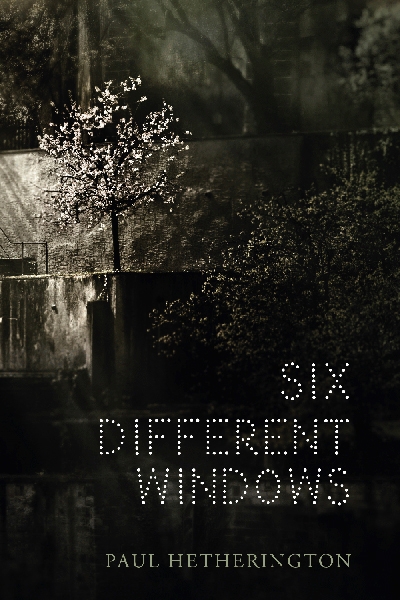
Pleasures of aporia: Paul Hetherington’s Six Different Windows

Six Different Windows by Paul HetheringtonSeen through one window, Paul Hetherington’s Six Different Windows appears to be a collection of poems concerned with the death of art. Such a theme is perhaps not surprising given that Hetherington, in addition to his seven books of poems, edited three volumes of Donald Friend’s diaries for the National Library of Australia, the last of which was shortlisted for a Manning Clark House National Cultural Award in 2006.

Creativity and its decline consume the collection. In a poem entitled ‘An Ageing Artist Reviews His Work’, a painter sets fire to two years of work; in ‘Artist’ – a poem that might, for its biographical correspondents, be about Friend – an irascible painter refines his style until he cannot write his name. In ‘London’, sculptures and paintings fill ‘every corner of seeing’ yet the speaker is gripped not by a celebration of form but a recognition of its lack: ‘We existed in a space that was skewed,’ he confesses, ‘disrupted, disowned, ill-conceived.’

The human form in its architectural glory is a frequent study in Six Different Windows. But just as frequently bodies find themselves at odds with the minds they house. In a love poem called ‘Holding’, a man grips a woman – her back arched, her head thrown back – as she falls away from him. ‘Time has no dimension’, he learns, beyond ‘the running steps of her rib cage’. In this unstructured moment, he has become ‘alien to himself’.

More than surfaces Hetherington’s poems prefer a view of the body’s interiors: ‘The blood was always there,’ a speaker observes in a poem that ruminates on childhood wounds and the mystery of girls’ menstruation. He considers his own body – ‘little more than a container / for the litres of blood’ – and marvels at ‘the body releasing itself / in a hundred ways – as if always / wanting to let go of itself’.

Yet form and body offer only one view into the collection. Hetherington wrote his doctoral dissertation on the poetry of Emily Dickinson, and his poems clearly stand in a tradition that upholds a poetry of mind. Hetherington’s poems are more sensual than Dickinson’s and make greater use of narrative, but the similarities extend beyond a passion for the em-dash. Both Dickinson and Hetherington are interested in the mental construct of ‘space’ more than the physical construct of ‘place’. And both take pleasure in a mind in disarray: the disjunctions of aporia provide the necessary kick to throw their poems into being.

For Hetherington, at least in his poems, the pleasures of aporia seem peculiarly female. While his male subjects are often alienated from their bodies and bemused by the loss of their generative powers, his female subjects are invigorated by emptiness, chaos, disobedience, and other improprieties. For them, the mind’s perceptions and processes are not to be controlled but played like a game: ‘Is the past like this,’ a speaker asks, ‘something to step into / like an antique dress-up?’

Hetherington’s women are usually found in transit. In the poem ‘Passport’, a gypsy on a train to Switzerland strips down to her ‘bra and colourful knickers’ in a moment of seeming madness. She remains silent and unperturbed by the passengers’ stares as guards wrap her in a blanket and escort her from the train. She has escaped, the speaker thinks admiringly, the ‘confined space called right behaviour / that we had entered and agreed to share’. In ‘Through A Window, Looking Back’, another woman watches the Italian countryside recede as her train speeds toward her lover. Her pleasure is not a simple sense of freedom from family and domestic routine, but a sensation of vertigo – ‘the stomach dropping into space / on a steep climb’ – that hits when she remembers:

how once they’d been at loggerheads
for two days, and on the third, had made love
and barely known each other
or themselves. She’d wanted to keep that –
the not-knowing, the animal life
that had risen. She had wanted
to stay strange to herself.

The collection concludes with a portrait of a woman – perhaps the one from the train – who, having hidden herself for too long in an inadequate marriage, has arrived at a villa in another country: ‘She’s in a room not far from where the sea / breaks across the rocks, loosening her blouse.’ Memories of her family dissolve into silence, and the absence of greeting delights her. The woman ‘handles her arms, strokes the skin / of her legs’ and ‘unpacks her heedlessness’.

Hetherington usually reserves this kind of reverie for female characters, with the exception, perhaps, of the beautiful poem ‘Dépaysement’, which pays homage, as the title suggests, to the generative powers of disorientation. Like many of the poems in Six Different Windows, it begins with a view of the world receding. But this time the speaker, it would seem, is male. The man is strolling down a street in Barcelona watching a church bell lurch on the horizon. A white dove batters a high pane of the old city’s cathedral. Inside, incense drifts like the snow until everything – the speaker’s body, the sky – is charged and ringing with the deepest of mysteries:

My body was tolled across time
as someone walked in my yard
tying back plants, puzzling at grace
under a clangorous sky.

Review of Six Different Windows by Paul Hetherington. Originally published in Australian Book Review (Sept 2013).