The roy davids collection: portraits of poets

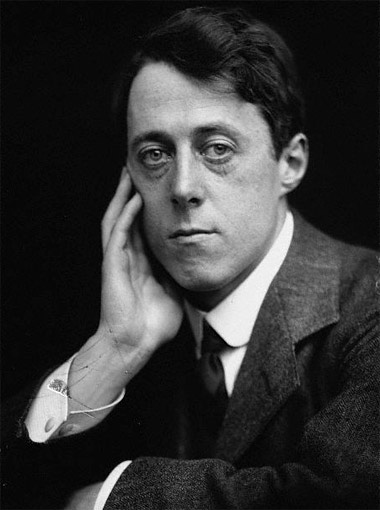
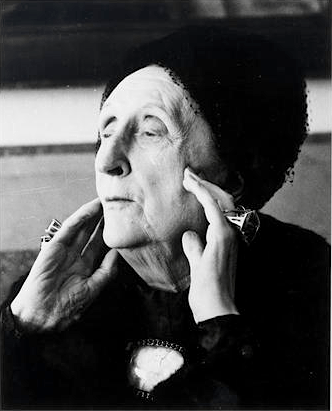
My wish list of photographs I’d like to buy at Bonham’s The Roy Davids Collection. Part III. Poetry: Poetical Manuscripts and Portraits of Poets. Estimated cost AU$18,050 = Stein: $800; Millay: $2,000; Dylan: $3,200; Moore: $3,200; Sitwell: $1,200; Jeffers: $2,400; Betjeman: $1,800; Baldwin: $700; Beckett: $2,750

My wish list of photographs I’d like to buy at Bonham’s The Roy Davids Collection. Part III. Poetry: Poetical Manuscripts and Portraits of Poets.

This slideshow requires JavaScript.

Estimated cost AU$18,050

Stein: $800; Millay: $2,000; Dylan: $3,200; Moore: $3,200; Sitwell: $1,200; Jeffers: $2,400; Betjeman: $1,800; Baldwin: $700; Beckett: $2,750

This year’s miles franklin is all woman

Well this is curious. Women outnumbered men on the Miles Franklin Literary Award shortlist by 4:1, and now the judges – for the first time in the Award’s 57-year history – have turned out a shortlist that is 100% female. The all-female shortlist comes less than two weeks after the inaugural Stella Prize of $50,000 for a book by a female Australian author was awarded to Carrie Tiffany for Mateship with Birds. The Stella, which retrieves the given-name Miles Franklin felt she needed to suppress in order to be taken seriously as a writer, was created in indignant response to the all-male shortlists the Franklin served up in 2009 and 2011.

milesWell this is curious. Women outnumbered men on the Miles Franklin Literary Award shortlist by 4:1, and now the judges – for the first time in the Award’s 57-year history – have turned out a shortlist that is 100% female:

The all-female shortlist comes less than two weeks after the inaugural Stella Prize of $50,000 for a book by a female Australian author was awarded to Carrie Tiffany for Mateship with Birds.

The Stella, which retrieves the given-name Miles Franklin felt she needed to suppress in order to be taken seriously as a writer, was created in indignant response to the all-male shortlists the Franklin served up in 2009 and 2011.

But any point of distinction the Stella Prize sought to make has not eventuated. In fact the 2013 Stella and Franklin shortlists look remarkably similar.

Not only are both lists composed entirely of women, but Tiffany and de Krester appear on both. And while first-time novelist Romy Ash fell off the Stella shortlist, she has held her ground in the Miles Franklin.

But in what appears to be a blatant – but not unwelcome – effort to muscle its way back to Australia’s top dog literary prize, this year the Miles Franklin has increased its cash prize by $10,000 to $60,000.

And Miles Franklin shortlisted authors needn’t feel pressured to follow Carrie Tiffany’s generous lead in returning $10,000 of her Stella Prize win to share equally among her shortlisted comrades.

In another new initiative, Miles Franklin shortlisted authors will be awarded $5,000 in prize money by the Copyright Agency’s Cultural Fund, a long term partner of the Miles Franklin Literary Award.

It’s a win-win situation, for Australian women authors at least.

Speaking on behalf of The Trust Company, which manages the estate of the late Miles Franklin, Simon Lewis congratulated all the shortlisted authors:

The shortlist demonstrates how strong Australia’s pipeline of female literary talent really is, as witnessed with last year’s Miles Franklin winner, Anna Funder, as well as by the growing number of first time female authors included in the long and shortlists in recent years.

“We look forward to announcing yet another outstanding Australian female literary talent on the 19 June as the 2013 Miles Franklin Award winner,” Mr Lewis said.

Since the Miles Franklin Award began in 1957, a woman has won only 14 times. This year the count creeps up to 15.

The Conversation

This article was originally published at The Conversation.
Read the original article.

Ambiguous agnes: hannah kent’s burial rites

Review of Burial Rites by Hannah Kent

A novel that can be summarised in a single, captivating sentence is a publisher’s dream. Not that ease of marketing is a reliable measure of excellence. Virginia Woolf’s To the Lighthouse (1927), for instance – which could be described as ‘the story of a mother who dies before taking her son to visit a lighthouse, and later a woman completes a painting’ – achieved classic status despite an unpropitious précis. Woolf’s genius aside, it is difficult to imagine a sentence like that sparking an international bidding war of the kind that erupted last year over Hannah Kent’s first novel. Burial Rites – ‘the story of the last woman to be beheaded in Iceland’ – reportedly netted Kent a considerable advance.

Burial Rites by Hannah KentA novel that can be summarised in a single, captivating sentence is a publisher’s dream. Not that ease of marketing is a reliable measure of excellence. Virginia Woolf’s To the Lighthouse (1927), for instance – which could be described as ‘the story of a mother who dies before taking her son to visit a lighthouse, and later a woman completes a painting’ – achieved classic status despite an unpropitious précis. Woolf’s genius aside, it is difficult to imagine a sentence like that sparking an international bidding war of the kind that erupted last year over Hannah Kent’s first novel. Burial Rites – ‘the story of the last woman to be beheaded in Iceland’ – reportedly netted Kent a considerable advance.

Kent’s novel has immediate appeal. Beyond the ghoulish fascination of beheadings, it taps into the prevailing hunger for historical fiction. Based on a true story, its cast of characters would seem implausible, were they not based on real people: Agnes Magnúsdóttir (1795–1830), a housekeeper who struggles, like Thomas Hardy’s Tess, against harsh and indifferent fates; Natan Ketilsson (1792–1828), a Rasputin-like herbalist and farmer who is Agnes’s employer and sometime lover; and Rósa Gudmundsdóttir (1795–1855), another of Natan’s lovers, who also happens to be one of Iceland’s most famous poets of the early nineteenth century.

Behind Agnes’s execution lies a double murder and a complex love triangle. This much is known: on a spring night in 1828, Agnes woke a neighbouring household to tell them that the Illugastaðir farmhouse was on fire. Natan and his friend Pétur Jónsson, she said, were trapped inside. Unfortunately for Agnes, the fire was quickly doused and it became clear that the two men had been stabbed before the blaze. Agnes was arrested, along with an avaricious farmhand named Fridrik and his sixteen-year-old girlfriend, Siggi, who was later sent to a Copenhagen textile prison. Agnes and Fridrik were beheaded by Natan’s brother on a small hillock in Húnavatnssýsla on 12 January 1830.

Kent has built her narrative around a small trove of historical documents associated with the murders: a public notice announcing an auction of Natan’s valuables (variously a cow, a few horses, sheep, a saddle, a bridle, some plates), a list of Agnes’s assets (among odds and ends, ‘an old blue skirt with a blue bodice of plain-woven wool, with a red collar and eight silver buttons’), extracts from the Supreme Court trials of 1829, and various contemporaneous eyewitness and character testimonies.

There is also an Icelandic Burial Hymn and an extract from the Laxdæla Saga, whose protagonist, Guðrún, laments: ‘I was worst to the one I loved best.’ Especially powerful is the exchange between Agnes and Skáld-Rósa. Although married and living with another man at the time, Rósa loved Natan passionately and reportedly bore him two children. In June 1828, following the murders, Rósa aired her heartbreak in a vindictive poem addressed to Agnes:

Don’t be surprised by the sorrow in my eyes
nor at the bitter pangs of pain that I feel:
For you have stolen with your scheming
he who gave my life meaning
and thrown your life to the Devil to deal.

Agnes, who was herself educated and literate, responded in verse:

This is my only wish to you,
bound in anger and grief:
Do not scratch my bleeding wounds,
I’m full of disbelief.

Agnes’s shock is palpable, yet the precise source of her disbelief is unclear: is it triggered by her grief at the death of the man she too loved, by an accusation of a crime she didn’t commit, or by fear at her impending death? It is the task of the novelist to decide.

Agnes and Fridrik were not permitted Christian burial rites: their heads were exhibited on sticks as warnings, and their bodies buried on site without markers. Nearly two hundred years later, Agnes now shares a modest grave with Fridrik in the churchyard at Tjörn. During the relocation of their remains, fragments from Agnes’s dress – she had dressed in her finest for her final moments – were found among her bones. They are exhibited in Iceland’s national museum, along with the axe that was sent to Iceland especially for the executions. It was used only twice.

Kent’s instinct for story is on bright display in Burial Rites. Over the years the murder case has been the source of much discussion in Iceland. Several books have appeared on the subject, and in 1995 a film entitled Agnes appeared by director Egill Eðvarðsson. Not that this would preclude yet another Holly-wood remake of a Scandinavian film.

Kent’s skill in driving the twin narratives of the murders and the executions to their ghastly inevitabilities demonstrates that she is a writer of great promise. Burial Rites is not a particularly challenging read, and it leans heavily on devices associated with genre fiction. But it does challenge the idea that Agnes is, as one source described her, ‘an inhuman witch, stirring up murder’. In the author’s note, Kent states that she wrote her novel ‘to supply a more ambiguous portrayal of this woman’. But Burial Rites is more than thisit is a love song to a woman who lived and loved with the odds stacked against her.

Review of Burial Rites by Hannah Kent. Originally published in Australian Book Review (May 2013).

Lest we forget: binyon’s ode of remembrance

First published in The Conversation

On an autumn day in 1914 Laurence Binyon sat on a cliff in North Cornwall, somewhere between Pentire Point and the Rump. It was less than seven weeks after the outbreak of war, but British casualties were mounting. Long lists of the dead and wounded were appearing in British newspapers. With the British Expeditionary Force in retreat from Mons, promises of a speedy end to war were fading fast. Against this backdrop Binyon, then Assistant Keeper of Prints and Drawings at the British Museum, sat to compose a poem that Rudyard Kipling would one day praise as “the most beautiful expression of sorrow in the English language”.
laurence_binyonOn an autumn day in 1914 Laurence Binyon sat on a cliff in North Cornwall, somewhere between Pentire Point and the Rump. It was less than seven weeks after the outbreak of war, but British casualties were mounting. Long lists of the dead and wounded were appearing in British newspapers. With the British Expeditionary Force in retreat from Mons, promises of a speedy end to war were fading.

Against this backdrop Binyon, then Assistant Keeper of Prints and Drawings at the British Museum, sat to compose a poem that Rudyard Kipling would one day praise as “the most beautiful expression of sorrow in the English language”.

For the Fallen”, as Binyon called his poem, was published in The Times on 21 September 1914. “The poem grew in stature as the war progressed”, Binyon’s biographer John Hatcher observed, “accommodating itself to the scale of the nation’s grief”.

Nearly a century on, Binyon’s poem endures as a dignified and solemn expression of loss. The fourth stanza – lifted to prominence as “The Ode of Remembrance” – is engraved on cenotaphs, war memorials and headstones in war cemeteries throughout the English-speaking world. Recited at Remembrance services in Britain, Canada, Australia and New Zealand, the poem serves as a secular prayer:

They shall grow not old, as we that are left grow old:
Age shall not weary them, nor the years condemn;
At the going down of the sun, and in the morning,
We will remember them.

These lines, situated at the heart of the poem, lay out an argument for consolation in which the dead are immortalised in the memory of the living.

Binyon died on 10 March 1943, and his ashes were scattered on the grounds of St Mary’s Church in Aldworth. His name is commemorated on a stone plaque in Poet’s Corner at Westminster Abbey, alongside 15 fellow poets of the Great War. Wilfred Owen – who died in action at age 25, exactly one week before the signing of the Armistice – provided the inscription: “My subject is War, and the pity of War. The Poetry is in the pity.”

the handwritten “ode”

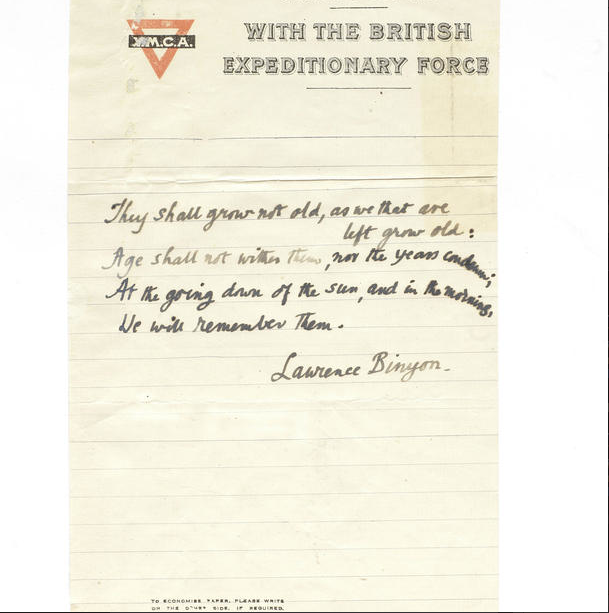
BINYON, LAURENCE (1869-1943) AUTOGRAPH MANUSCRIPT OF THE IMMORTAL FOURTH STANZA OF HIS POEM 'FOR THE FALLEN',Earlier this month, “an autograph manuscript of the immortal fourth stanza”, signed by Laurence Binyon, came up for auction at Bonhams. The manuscript is a mere four lines, written in Binyon’s hand, on a single octavo page of ruled notepaper. The header contains a YMCA symbol and the imprimatur of the British Expeditionary Force (BEF). Small letters at the foot instruct: “To economise paper, please write on the other side, if required”.

Binyon did not date the manuscript, but he likely penned it before the war ended in 1918. The BEF notepaper adds a particular poignancy, as the poem was written to honour British soldiers who died on the Western Front – many of whom Binyon, as a volunteer medic, would have served alongside.

controversies

Every year, after ANZAC Day and Remembrance Day, the Department of Veterans’ Affairs in Australia receives scores of letters about “The Ode”. The issue of greatest concern, according to the DVA, is whether the last word of the second line should be “contemn” – meaning to despise or treat with disregard – or “condemn”. Both words fit the context.

Despite all official versions of the poem using “condemn”, some people have suggested this usage is a typographical error.The British Society of Authors, executors of the Binyon estate, is adamant that “condemn” is correct. Likewise the DVA assures: “Binyon was very precise in his use of words. There is no doubt that had he intended ‘contemn’, then it would have been used.”

The condemn/contemn issue is considered a distinctly Australian phenomenon (oddly, the Academy of American Poets uses “contemn” in its publication of “For the Fallen”). Perhaps now, with confirmation coming from Binyon’s own hand, the issue may be put to rest.

But that’s not the only anomaly. In the Bonhams manuscript, Binyon has used an alternative construction of the famous second line. Instead of “weary” he uses “wither”, which echoes Enobarbus’s compliment to Cleopatra – “Age cannot wither her, nor custom stale / Her infinite variety” – in Shakespeare’s Antony and Cleopatra. “Immature poets imitate; mature poets steal”, so TS Eliot posited in The Sacred Wood. “For the Fallen” might be uneven in quality, but in turning his theft “into a whole of feeling which is unique, utterly different than that from which it is torn”, Binyon proves himself to be a great poet.

the sale

Bonhams expected Binyon’s manuscript to fetch around £5,000, but the poem once again exceeded expectations when an unnamed buyer parted with £10,000 (AU$15,000) for the honour of holding history in his or her hands.

The Conversation

This article was originally published at The Conversation.
Read the original article.
The wrap: poetry in the news (w/e 25 apr 2013)

In Los Angeles, a Harvard poet wondered ”Is this too loud, is this too soft, am I going on too long?” while Sharon Olds put the ideal of her husband to rest and won the Pulitzer Prize for Poetry. Anne Carson published a poem composed using a random integer generator in the London Review of Books, and James Franco released a poem on the occasion of his 35th birthday. Bollywood heartthrob Farhan Akhtar penned a poem after hearing a five-year-old girl in Delhi had been raped and tortured by her neighbour. Dresden Dolls singer Amanda Palmer penned “the worst poem of all time“ in her musings on the younger Boston Marathon bomber. Historians noted 397 and 189 years have passed since Shakespeare and Byron, respectively, died of fevers.

newspaper-icon-thumb10559428In Los Angeles, a Harvard poet wondered “Is this too loud, is this too soft, am I going on too long?” while Sharon Olds put the ideal of her husband to rest and won the Pulitzer Prize for Poetry. Anne Carson published a poem composed using a random integer generator in the London Review of Books, and James Franco released a poem on the occasion of his 35th birthday. Bollywood heartthrob Farhan Akhtar penned a poem after hearing a five-year-old girl in Delhi had been raped and tortured by her neighbour. Dresden Dolls singer Amanda Palmer penned “the worst poem of all time” in her musings on the younger Boston Marathon bomber. Historians noted 397 and 189 years have passed since Shakespeare and Byron, respectively, died of fevers. The only known poem by Winston Churchill, “Our Modern Watchwords“, failed to sell at an auction at Bonhams. The priest who found Malta’s earliest poem died at age 97, and Irish rare-book collector Rick Gekoski prayed that the poem James Joyce wrote as a little boy – “Et Tu, Healy” will never be found.

Simon armitage: walking home backwards

Review of Walking Home by Simon Armitage

Wordsworth – poet–walker par excellence – had the best legs in the business. As his friend Thomas de Quincy noted: ‘Undoubtedly they had been serviceable legs beyond the average standard of requisition. For I calculate, upon good data, that with these identical legs Wordsworth must have traversed a distance of 185,000 English miles.’ In contrast, Simon Armitage’s legs, by his own admission, generally ‘do very little other than dangle under a desk’ or propel him from the multi-storey car park to the railway ticket office. ‘Even if I’m writing about the Sahara or the Antarctic,’ he confesses, ‘I’m usually doing it in a chair, in a room, behind double glazing.’

Simon-Armitage-297x300Wordsworth – poet–walker par excellence – had the best legs in the business. As his friend Thomas de Quincy noted: ‘Undoubtedly they had been serviceable legs beyond the average standard of requisition. For I calculate, upon good data, that with these identical legs Wordsworth must have traversed a distance of 185,000 English miles.’ In contrast, Simon Armitage’s legs, by his own admission, generally ‘do very little other than dangle under a desk’ or propel him from the multi-storey car park to the railway ticket office. ‘Even if I’m writing about the Sahara or the Antarctic,’ he confesses, ‘I’m usually doing it in a chair, in a room, behind double glazing.’

In 1994 Armitage swapped social work for poetry and quickly became the most recognisable face in Britain’s so-called New Generation poets. Since then he has written fifteen collections of poetry, eleven radio documentaries and verse dramas, two novels, and several non-fiction titles. He has also edited five poetry anthologies – including a new selection of Ted Hughes’s poems – and published new translations of The Odyssey, Sir Gawain and The Green Knight, and The Death of King Arthur. But by 2011 the stodginess of routine had set in; the sediment was building up. So Armitage decided to take a walk.

The Pennine Way, measuring 256 miles (410 kilometres, or roughly the distance from Coff’s Harbour to Brisbane) of adversarial terrain, is generally considered the most demanding long-distance walk in Britain. The route begins in the peat moorlands of Kinder Scout, Bleaklow, and Black Hill, stretches along England’s unbroken spine of bleak hill country, across Hadrian’s Wall and traversing half the Cheviot ridge before terminating in the Scottish border village of Kirk Yetholm.

At least that is the way it is supposed to go. But Armitage – sporting a bad back and the ‘small lungs’ he inherited from his mother – sets out from Scotland to walk the Pennine Way south toward his hometown of Marsden in West Yorkshire. Instead of the weather at his back, Armitage walks headlong into a wind so powerful he has to lift his knees high and cycle into it. Crossing Haughton Common, the wind is so adamant in its opposition that ‘any progress is progress upstream, against the flood, into the rapids, with boulders and logs of hard air’ piling into him and knocking him sideways. It is the medicine he has been looking for:

And I think: this is why I came, to stumble into the unexpected, to feel the world in its raw state. I open my mouth to shout MORE, but the force of air just rams the word back into my mouth and down my throat.

Walking the Pennine Way backwards not only allows Armitage to air his poetic bent for perversity, but also launches the titular metaphor that makes this narrative a homecoming. Armitage was born in 1963 in the West Yorkshire village of Marsden, nestled not far from the trailhead. It is the pull of home – the promise of returning to his wife and daughter – that keeps him walking when his loneliness bites and his sense of humour fails.

Armitage trudges through England’s most literary landscapes – passing by Wordsworth’s Aira Force (‘what a sight it is to look on such a cataract’) and sleeping in Hughes’s childhood home in Mytholmroyd – but Walking Home is not a literary pilgrimage. Homage, if any is to be paid, is to Odysseus and his legendary yearning for home.

In the course of ten years, Odysseus outwits the Cyclops, is spellbound by the Sirens, sees his crew turned into pigs, is kept as a love-slave, and slays his wife’s suitors before reuniting with Penelope in the marital bed. Armitage’s conquests are not quite so formidable, nor as eldritch. He keeps careful inventory of his wounds: five horsefly bites, a bloody thumb, soreness in big toe of right foot when bent backwards, windburn, chapped lips, and wounded pride. Happily, he is spared blisters.
For reasons best described as masochistic, Armitage elected to finance his journey by giving nightly poetry readings at pubs and in private homes along the way. His Sisyphean efforts netted him nearly £2000 for his trouble and provided endless opportunities for poetry gags: ‘In the presence of the spoken word,’ he observes, ‘the scrape of knife against plate or the opening of a packet of salted peanuts are nuclear explosions.’

It is not giving anything away to say that the journey is not entirely successful. Neither is the book. It is – to use an Armitage word – a little bit ‘boring’, partly because each leg of the journey follows the same formula: a walk, a quirky fan, a beer, an awkward poetry reading, the scrutiny of his takings (not always cash); and partly because the narrator is often damp, chilly, shaken up, and in a bit of a sulk.

‘In many ways,’ Armitage says, ‘the Pennine Way is a pointless exercise, leading from nowhere in particular to nowhere in particular, via no particular route and for no particular reason.’ Asked if he would walk the Pennine Way again, his routine answer is no. ‘But if I did,’ he relents, ‘I’d rely more on my feet and less on my tongue.’

He would also take someone brave and intrepid with him: ‘Someone not daunted by mist or intimidated by dark clouds, to guide me across the Cheviots, to hold my hand over Cross Fell, and to part the black curtain which hangs over Kinder Scout and lead me through.’

This article was originally published under the title ‘A Pack of Salted Peanuts’ in Australian Book Review 348 (Feb 2013): 56-57.

You might also like

The blood became sick: Luke Davies’ Interferon Psalms
Rhyll McMaster’s Mere Self
Mateship with Birds: you have to push in
Ted Hughes: she sent him a blade of grass

Carrie tiffany wins a stella prize of her own

The Stella Prize, which comes with a whopping $50,000 purse, is Australia’s newest literary prize celebrating Australian women authors. Australia’s other “gendered” prizes for literature include The Kibble Literary Award ($30,000) for a fiction or nonfiction book by an established Australian woman writer; and The Dobbie Literary Award ($5,000) for a first published work by an Australian woman writer. Australian women writers are also eligible to enter Britain’s The Women’s Prize for Fiction (AU$45,000), awarded to a female author of any nationality for the best original full-length novel written in English. It is not impossible that a first book by an Australian woman author could sweep all of these prizes in a literary superfecta amassing a tidy $130,000.

stella-logo-largeThe Stella Prize, which comes with a whopping $50,000 purse, is Australia’s newest literary prize celebrating Australian women authors. Australia’s other “gendered” prizes for literature include The Kibble Literary Award ($30,000) for a fiction or nonfiction book by an established Australian woman writer; and The Dobbie Literary Award ($5,000) for a first published work by an Australian woman writer. Australian women writers are also eligible to enter Britain’s The Women’s Prize for Fiction (£30,000/AU$45,000), awarded to a female author of any nationality for the best original full-length novel written in English.

It is not impossible that a first book by an Australian woman author could sweep all of these prizes in a literary superfecta amassing a tidy $130,000. Which is exactly what Carrie Tiffany – who last night was awarded the inaugural Stella Prize for her novel, Mateship with Birds – looks set to do.

Of course Tiffany can’t win the Dobbie because Mateship with Birds is her second novel. But that shouldn’t worry her greatly, as she already won it in 2007 for her debut novel, Everyman’s Rules for Scientific Living.

In addition to last night’s win, Mateship with Birds is currently longlisted for the Kibble and the Women’s Prize for Fiction. And it might even pick up The Barbara Jefferis Award – a $35,000 prize for “the best novel written by an Australian author that depicts women and girls in a positive way or otherwise empowers the status of women and girls in society” – which is yet to release a shortlist.

It does’t end there. Mateship with Birds is also longlisted for Australia’s most prestigious literary award, The Miles Franklin, which fueled the gender debate when it served up all-male shortlists in 2009 and 2011. Perhaps in response to these criticisms, this year’s longlist sees the largest number of female authors selected since the longlist was first introduced in 2005.

Of winning the Stella Prize, Tiffany said: “It is astonishing and lovely to be the first recipient of this new prize. The Stella Prize is an opportunity to fete and honour writing by Australian women.

When I sit down to write I am anchored by all of the books I have read. My sentences would not have been possible without the sentences of Christina Stead, Thea Astley, Elizabeth Jolley, Beverley Farmer, Kate Grenville, Gillian Mears, Helen Garner and the many other fine Australian writers that I have read and continue to read.

At the award night, Tiffany announced that she wanted to donate $10,000 of the Stella prize money back to be split equally among the other five shortlistees:

  • The Burial by Courtney Collins (Allen & Unwin)
  • Questions of Travel by Michelle de Kretser (Allen & Unwin)
  • The Sunlit Zone by Lisa Jacobson (Five Islands Press)
  • Like a House on Fire by Cate Kennedy (Scribe Publications)
  • Sea Hearts by Margo Lanagan (Allen & Unwin)

The Conversation

This article was originally published at The Conversation.
Read the original article.


May 31: shoalhaven literary award

The Shoalhaven Literary Award for short stories 2013 is now open. The judge this year will be Moya Simons. First Prize $1000 plus a two-week artist’s residency at Bundanon. Closing date: 31 May 2013.

The Shoalhaven Literary Award for short stories is now open. The judge this year will be Moya Simons. First Prize $1000 plus a two-week artist’s residency at Bundanon. Closing date: 31 May 2013.

Return

May 24: queensland literary awards

The Queensland Literary Awards (QLA) is Queensland’s most significant suite of literary prizes. A $5,000 prize will be awarded in each award category. Nominations close 5pm 24 May 2013.

The Queensland Literary Awards is Queensland’s most significant suite of literary prizes. A $5,000 prize will be awarded in each award category. Nominations close 5pm 24 May 2013.

2013 Award Categories

May 31: elizabeth jolley short story prize

The Australian Book Review Elizabeth Jolley Short Story Prize is for a short story in English of between 2000 and 5000 words. The prize will be judged by Tony Birch, Maria Takolander and Terri-ann White and first prize is AUD$5,000. Entries close 31 May.

The Australian Book Review Elizabeth Jolley Short Story Prize is for a short story in English of between 2000 and 5000 words. The prize will be judged by Tony Birch, Maria Takolander and Terri-ann White and first prize is AUD$5,000. Entries close 31 May.

RETURN