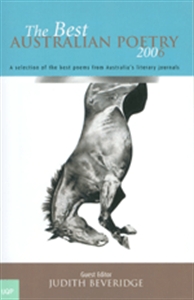
Foreword: The Best Australian Poetry 2009

The guest editor of this year’s Best Australian Poetry selection is probably best known for his huge verse novel, The Lovemakers, and for his recent collection of short poems largely inspired by local popular songs. He is, as I have said elsewhere, a master of the infinite complexity of Australian social life. He is endlessly inquisitive (in a way that used to be expected of novelists) about the details of an individual’s public and inner life, where the character derives from and how it expresses itself in details. The Lovemakers was not only a study of individuals but also of entrepreneurialism in business (and its counterpart, the drug trade), of Australian sport, and of the legal system, to name only the most important.

Guest Editor: Alan Wearne

Guest editor: Alan Wearne
Series editors: Bronwyn Lea and Martin Duwell

The guest editor of this year’s Best Australian Poetry selection is probably best known for his huge verse novel, The Lovemakers, and for his recent collection of short poems largely inspired by local popular songs. He is, as I have said elsewhere, a master of the infinite complexity of Australian social life. He is endlessly inquisitive (in a way that used to be expected of novelists) about the details of an individual’s public and inner life, where the character derives from and how it expresses itself in details. The Lovemakers was not only a study of individuals but also of entrepreneurialism in business (and its counterpart, the drug trade), of Australian sport, and of the legal system, to name only the most important. The earlier verse novel, The Nightmarkets, looked at the relationships between people, especially in political life, but, just as big business was counterbalanced by the drug trade in The Lovemakers, so the sex trade counterbalanced politics in The Nightmarkets. The ambition, the extraordinary sensitivity to telling detail in an individual’s life, and a command of the complex, larger structures in which these lives are lived, mean that Wearne’s work always makes me think of Dickens, the Dickens of Bleak House, Little Dorrit and Dombey and Son. I think I am right in saying that this is the first time he has been involved in editing – in the sense of making a selection of poems. He is better known, perhaps, as a teacher of writing; but teaching and editing are not dissimilar processes.

It is an overused commonplace that poetry is double-faced in that it can look inwards towards itself, its own material – language – and its own craft, and, at the same time, look outwards to the social world. Some of the collections in our series have clearly favoured the latter view, sometimes emphasising the drama of lives, sometimes the process of living. Alan Wearne’s selection is one which might be considered rich in portraiture, indeed it might almost seem as though its function was to remind us that there are many radically different ways in which poems can portray lives. And when Wearne writes, in his introduction, of the surprises in the poems that he read for this volume, one cannot help but think that often this resulted from an expert being introduced to new possible ways of doing what he does habitually.

At one end of the spectrum are poems like John West’s ‘Chelsea Women’ and John Carey’s ‘Fidel’s Children’ which work by aggregating quick sketches into a portrait of a larger whole. Each poet’s feeling for the extraordinariness of the lives they capture dominates their poem and it is difficult not to feel that the individual lives are more significant than the social structure in which they occur, though to deal with questions like this – something poetry is perfectly entitled to do – is to enter a very conflicted corner of intellectual questioning. At the other end, so to speak, are poems which portray their writer in a way that we are used to in lyric poetry. The haiku series of Rosemary Dobson and Graham Nunn describe the self by rendering impressions. The poems by Kelly Pilgrim-Byrne and Katherine Heneghan portray the poet’s self by focusing on something tangentially but importantly relevant. Peter Steele’s ‘Mending Gloves at Anglesea’ is also a gentle self-portrait facing the large question of poetry’s function in the world of power and deciding that, though lightweights ‘in the contest for chief lout’, poets have their own function. Geoffrey Lehmann describes his marvellous, extended poem of travels in Peru as a contribution to the new and ‘suspect’ genre of Baedeker poems but, like all good travel literature, it, too, is a portrait of the self, made slightly ridiculous, slightly insignificant but hyper-sensitive in an alien environment, in the way of much good travel writing.

Other poems are straightforward portraits. In Ali Alizadeh’s cleverly titled ‘The Suspect’, in Kate Lilley’s ‘Pet’ and L.K. Holt’s ‘Menis’ we are given clear studies and suffer the important frustration of all readers in not knowing what the author’s relationship to the portrait is. And then there is Maria Takolander’s ‘Witch’, which seems to be a portrait of a hypothetical person constructed out of a set of prejudices, and Geoff Page’s ‘Dining with the Pure Merinos’, which is a generalised, witty and not too cruel portrait of an entire class.

The act of looking at this volume as a kind of anatomy of portraiture draws attention to those poems which are overtly about the issues of the portrait. Peter Porter’s ‘We Do Not Write What We Are’ focuses on the question of poetry as self-portrait, wondering which self – the self of dreams or the self of the ordinary daylight world – appears in poems. Geoff Goodfellow’s ‘Finding Myself’, which seems, initially, to be a poem about the self recovering from very serious surgery, finishes with an image of the razor scraping away all that separates him from being a clone of his father. In this respect, purely accidentally, Tom Shapcott’s ‘Sestina’ places itself at the centre of the stage since it worries – in that obsessive way that sestinas do — about how much our prized individuality is a result of a determinist genetic heritage; as the poem says:

We do not start with a blank sheet, our genes
See to that. There is an itch somewhere in the shadows.

It would not be possible to write about Australian poetry in this year without visiting the sad fact of the death of Dorothy Porter. Her passing, late last year, at such an early age has taken from the community of Australian writers and readers one of our most loved poets. Remarkably, and almost uniquely for an Australian poet, her death attracted obituaries in overseas newspapers. She is most admired, at the moment, for a series of verse narratives beginning with Akhenaten and climaxing in The Monkey’s Mask. Good as these are, I suspect that they draw attention away from books like Driving too Fast and, especially, Crete – which remains my favourite of all her works. She was, pre-eminently, a poet of passion and, though the verse novels dealt with this theme in larger contexts, I can’t help feeling that its natural mode is the explosive lyric. She was a master – or mistress – of such poetry. Poems like ‘Why I Love Your Body’ and ‘My At-last Lover’ are hard to forget, genuine contributions to poetry’s most fully stocked, and hence most competitive, shelf. I love her comment, in an interview, about poetry and the -isms which bedevil intellectual life: ‘I don’t hold an ideological brief when I explore love or passion, I just go in and see what happens’.

YOU MIGHT ALSO LIKE

The Best Australian Poetry forewords
Australian Poetry Journal forewords

Silence that rings

Lyn McCredden reviews The Other Way Out (Giramondo, 2008) by Bronwyn Lea. This first appeared in Australian Book Review (March, 2009): 47.

by Lyn McCredden

These are witty, sometimes boisterous and meditative poems. There is a consistency of craft but an intriguing variety, and perhaps even contradictoriness, to their desires. Each poem is a little box of longing: for courage, for calmness, for love, for transcendence. Equally, the poems are often pleas for the self to abandon desire in its grasping forms, ‘to be whittled down to a twig & grow again into a tree’.

‘Two Ways Out’, the eponymous poem, lays out the map of the book: the human, desiring machine who must choose between opposing impulses: the ascetic and the rococo, two distinct paths by which to escape ‘the insufferable / medium of a par-boiled heart’. The poem, as with the volume, leaves you understanding something of both poetic journeys. Sometimes the two collide or are enmeshed in each other, in the figure of the poet who craves transcendence but who is impatient, who hasn’t ‘time to wait for grace’.

First, we are presented with attentiveness and an openness to the world; these qualities inform some of the quieter poems. ‘These Gifts’ records the way ‘the day has charmed you / with ephemera before you can object’. The fear of ‘Women of a Certain Age’ is stilled, but only momentarily, by an imagined world, ‘a new hospitable household’. In ‘Crows’, the desire is the search for ‘How to be / faithful to  the  crow-stepped  branch,  how to write / crow-scent in a human score’.

In such poems, we read the rich lyrical traces of Romantic attentiveness to the natural world, experienced as balm and nurse; but often it is with a very contemporary twist, a shaft of anti-Romantic and often humorous realism. ‘Crows’, for example, is a wonderful revelry on the dawn chorus of birds which ends with ‘the aural world giving / feedback,  shrieking like a microphone / too close to a speaker / & exploding into applause’. Ecstasy and discord enmeshed; the Romantic and the modern.

The second section of the volume, pop-culturally entitled ‘Where Is the Love?’, reflects modernity, but often through subtle contrasts. Individual poems may be set  historically, such as ‘The Nightgown’ with its distilled picture of ‘the Japanese woman in her desire’ who ‘commits to a life of dreaming / whether the lover appears or he doesn’t’. But the next poem, ‘Born Again’, is a tough and deliberate contrast, a revelation of modern desire: the divorced couple, the hatred still simmering, the bloody battle of the genders. Yet, in this raw evocation of modern love, there is the surprise of realisation in the observing wife, touched by grace and a vision of intimacy she imagines but has never experienced.

Love, or rather lost or broken love, permeates this section. The poems are never simply nostalgic or sentimental. ‘Routine Love Poem’, for example, could hardly be described thus. It is hard-nosed but with a deep draught of terror running through it. It is a confrontational poem, but also one which measures what is lacking, what might have been, in some better world beyond the repetitive, mechanical ‘they make & remake the coffee / they make and remake the bed’.

This is a wonderful, culminating evocation of the whole volume’s philosophy: inclined to the ascetic, but equally to action, involvement, making.

The volume’s final section, ‘The Way into Stone’, brings the reader to another way of negotiating desire, with its Buddhist-inflected meditations. Here we are led to think back on that earlier choice between ascetic and rococo paths. The bell and the stone deliver their quiet, post-human calm, ‘alert to the silence that rings’. But we find here, too, a number of exhortations to courage, the decision to take ‘A breath, a step, a word’ and to make a beginning. The human starting point is seen constantly to be ‘insufficient knowledge’. But from such a place humans begin with hope, perhaps enabled by ignorance of the pain that awaits  them. So we read of ‘The  Isurumuniya Lovers’ from Anuradhapura, fifth century CE, who experience ‘the sweet flood between us’, enjoying each other absolutely ‘in staggered silence till the future came / to blind us with its mirror’, another version of the fall.

The final poem of the collection, ‘The Bodhisattva’s Hand’, is a fine meditation on peace, but also on action and courage infused with that peace. Gazing on the ancient sculpture, the poet observer depicts ‘this figure peaceful as a stick of green bamboo’, and tells us: ‘The hand calls us into the moment / in which the infinite crosses over into gladness / & we gaze at something singular & joined.’ This is a wonderful, culminating evocation of the whole volume’s philosophy: inclined to the ascetic, but equally to action, involvement, making. In fact, both inclinations, shared by many poets, are bound together in a dialogue: silence and words, peace and desiring, transcendence from this  world and being steeped in the world. So the final wisdom, earned by the accumulative power of the poetry and convincing, is in doubleness of ‘Accept the gift which is not transcendence // but your heart beating at its apprehension. / Here  is  your  life: unlock your fist & begin’. In this exhortation, we are taken back to the poetry of T.S. Eliot, cited on the opening page of the volume, especially perhaps to Eliot’s Four Quartets, with its own poetic movement between meditation and action.

Every phrase and every sentence is an end and a beginning,
Every poem an epitaph. And any action
Is a step to the block, to the fire, down the sea’s throat
Or to an illegible stone: and that is where we start.

Lyn McCredden reviews The Other Way Out (Giramondo, 2008) by Bronwyn Lea. This first appeared in Australian Book Review (March, 2009): 47.

Fine connections in touching lines

Geoff Page reviews The Other Way Out (Giramondo, 2008). This first appeared in The Canberra Times (13 December 2008): 16.

by Geoff Page

It’s been seven years since Bronwyn Lea’s remarkable first book of poetry, Flight Animals. Now, at last, we have its successor, The Other Way Out: New Poems. The initial collection was marked by a consistent level of technical excellence and an impressive variety of form and tone. The second, luckily, lives up to the very high standard Lea created for herself. Perhaps that is why she has waited so long.

The new book falls into three parts: the first dealing mainly with issues of life and death, the second revisiting an intense love affair and the third meditating, among other subjects, on Eastern religions and the architecture and art they have given rise to. The poems in all three sections are finely but unobtrusively tuned and build, typically, to a highly memorable last line.

In ‘Dog Days’, for instance, her sonnet on Brisbane, she uses a variety of images to evoke the relentlessness of that city’s midsummer heat: ‘The sky is a blue so pressing it falls/like glass to the ground.’ She finds herself drawn by ‘hope’ to the river and concludes her poem by noting how ‘Today the water slides by/in silence, a quavering less oppressive city //splayed upside down on the surface./A dog barks in the white light, just once.’ That ‘just once’ is a typical Lea touch, a nicely resonant full stop to the whole poem.

A similar compression and understatedness can be seen in Lea’s poem, ‘Ars Poetica’. It’s short enough to quote in its entirety and is plainly indicative of where she is heading in this second collection: ‘I used to want/to say one thing //& have it turn/out to be another./Now I only want //to say one thing./As if the pleasure //now is in the voicing/not the trickery //but the soul making/itself heard //above the traffic.’

There was not very much ‘trickery’ in Flight Animals but one can sense here the eloquent simplicity Lea is reaching for. Some of the poems, for example, ‘Love Begins with a Vision’ and ‘View from the Blue Pavilion’, read like haiku sequences. Others, such as the technically ambitious ‘Routine Love Poem’, use the repetition of simple elements, almost in the manner of a Gertrude Stein or Samuel Beckett. The poem also displays the persistent ambivalence running through many of the erotic love poems at the book’s centre. In ‘Palinode’, for instance, Lea begins ‘I have written before how I loved him/ but I have never written how I disliked him too.’ In ‘Born Again’ she has the deliciously malevolent lines: ‘Instead of dying, god spoke to him./God forgave all his trespasses. But I/didn’t forgive his trespasses against me./My heart was a long ledger.’

This degree of intensity carries over to into the book’s final section which, while it touches on temples, pavilions and terracotta warriors, is just as much concerned with the raw force of human emotions. We are given, for instance, Lea’s versions of the graffiti at Sigiriya, written between the seventh and 11th centuries AD. They begin: ‘I came & saw the girls with gold chains/between their breasts now heaven is no good.’

Another poem in the sequence has Lea’s narrator reminiscing: ‘Each night/I found the present-tense of you: your body/in the bed conducting light,/the little room lit up, my sex ransacked/by a branch of burning sky.’ This might sound melodramatic but the poem’s ending is convincing enough: ‘Each morning we walked/ in staggered silence till the future came/to blind us with its mirror.’

In some other poems in the last section (such, for instance, the deeply moving ‘Father and Daughter’) there can sometimes be, by contrast, an almost risky minimalism but these are dangers Bronwyn Lea is more than willing to deal with in her pursuit of the subtlety she aims for. The Other Way Out will be more than satisfying to the many readers who have waited since Flight Animals in 2001 alerted them to the presence of a poet who has, as Alan Gould has put it, ‘the humour … the tact … and the fine connections of a very singular sensibility’.

Geoff Page reviews The Other Way Out (Giramondo, 2008). This first appeared in The Canberra Times (13 December 2008): 16.


Poetic intimacies to be shared

Geoffrey Lehmann reviews The Other Way Out (Giramondo, 2008) by Bronwyn Lea. This extract first appeared in The Weekend Australian 6-7 Dec 2008: Review 8-9.

by Geoffrey Lehmann

Why do people write poetry? Unlike Damien Hirst, who auctions artworks fabricated in his workshops for millions of pounds, poets get little money from their poetry. Nor is there much fame, and sometimes it seems as though there are more poets than poetry readers.

So why write poems? One reason may be the longevity of a good poem. Thousands of lines of ancient Greek poetry have survived for more than two millennia. This compares with some rare fragments of their music (less than 50 minutes recorded for Harmonia Mundi in 1978), none of their paintings (although they ranked this art form with their sculpture) and a few remnants of their best sculpture.

Poetry is like bits of DNA. It codes itself into our minds and transports itself down generations, popping out at odd moments, such as the poem by W.H. Auden read out in the film Four Weddings and a Funeral. But it is still worrying. Where will the new good poets come from?

It’s therefore a great relief to read Bronwyn Lea’s The Other Way Out. Still a year or so short of 40, Lea may be the brightest light to emerge in Australian poetry since the start of this decade. Her poetry is intense, personal, intelligent and witty. She is able to make her lines move briskly and economically and create surprises. In ‘Born Again’, which is surely a modern classic, she describes a divorce from a man

who sold his house
by the beach and drove his Volkswagen
into the desert to die. He was gone
a year. I was living one vertical mile
above the desert floor – where he slept
in his car.

The vivid detail about living one vertical mile above the desert floor puzzled me for a few days. Then I realised I’d been a bit stupid. The persona of the poem, presumably Lea during her years in the US, had gone to live in a mountain region such as Colorado, where she would be one vertical mile above the desert floor. The ex-husband doesn’t die as he’d planned. He becomes a ‘born again’.

‘Instead of dying, god spoke to him./God forgave all his trespasses. But I / didn’t forgive his trespasses against me. / My heart has a long ledger.’

The ex-husband comes to collect his daughter from the mother’s snowbound house, presumably on parental access. The mother gathers her daughter’s things. ‘It took a little while. When / I returned he was gone. Typical.’ She looks around and discovers him praying in the snow. In an ironic conclusion, Lea recalls:

Snow collected on his upturned palms.
I felt its coldness. Such intimacy
we had never shared. Sometimes grace
Comes like that, it falls like snow.

Geoffrey Lehmann reviews The Other Way Out (Giramondo, 2008) by Bronwyn Lea. This extract first appeared in The Weekend Australian 6-7 Dec 2008: Review 8-9.


Foreword: The Best Australian Poetry 2007

The editor of the fifth volume in our series does, literally, need no introduction, at least for most readers of Australian poetry. Since the mid-sixties John Tranter has been a continuous, modernising force in our poetry, and, more recently, risen to the point where he is acknowledged as one of a select few of Australia’s really great poets.

Guest Editor: John TranterGuest editor: John Tranter
Series editors: Bronwyn Lea and Martin Duwell

The editor of this, the fifth volume in our series does, literally, need no introduction, at least for most readers of Australian poetry. Since the mid-sixties John Tranter has been a continuous, modernising force in our poetry and, more recently, risen to the point where he is acknowledged as one of a select few of Australia’s really great poets. His poetry, as shown in his most recent New and Selected poems, Urban Myths (UQP, 2006), is a complex mix of abstraction and concreteness (he writes as well about the ambience of Sydney, his home town, as any poet), experiment and nostalgia (it is remarkable how often the rural world of his adolescence emerges in the poems). He is also a formal master, reinvigorating old forms and inventing new ones. It is worth noting that Tranter has also been an editor of and for magazines. At the moment he is the editor of an online journal, Jacket, which many people have thought – and said – is the best of its kind in the world.

Perhaps less well-known is the fact that Tranter is an anthologist of real importance. Most will know of his anthology of the group of poets to which, in terms of literary history, he belongs, The New Australian Poetry (Makar, 1979) and of his editing, with Philip Mead, The Penguin Book of Modern Australian Poetry (Penguin, 1991). The second of these surprised many readers, who perhaps feared a stony-hearted, experimental rigorousness, by its generous inclusiveness. Less well-known are Tranter’s Preface to the Seventies – a prescient selection of new poets published by Poetry Australia – and The Tin Wash Dish (ABC, 1989) – a selection of poems made from entries in a bi-centennial competition run jointly by the Australian Broadcasting Corporation and the Australian Bicentennial Authority. Again, what stood out, was its editor’s love of poetry and of the surprises it can bring. As he says:

I saw a chance to compile a genuinely democratic collection of poems by all sorts of Australians, all living and writing in the late 1980s, about every theme imaginable, in every style and form under the Australian sun. Perhaps it’s only now, at the beginning of the third century of white colonisation, when we have learnt to face the often unpleasant facts of our history and the difficult compromises of our social and cultural mix, that an authentic Australian voice can begin to be heard. If so it’s a voice rich with diversity.

‘Rich with diversity’ sounds very like the keynote of The Best Australian Poetry 2007.

All poems are built along an axis with Life at one end and Art at the other. Some – Tranter’s own work is an example, as is Robert Adamson’s, though in a very different way – negotiate this binary with more complexity than others. Some seem to speak simply about, to represent, the world but are in acknowledged or unacknowledged ways verbal creations true to laws which are the laws or art not the world. Others may take the  inside of the mind as their subject – meditations – but are never entirely divorced from the world – which is, after all, if nothing else, the home of their metaphors. Others attempt to be entirely referential, to live inside the world of art or its equally complicated friend, language, but even the most abstract or self-referential of works is an object in the world. Many readers of this anthology will expect from someone with Tranter’s reputation as a high postmodernist an anthology of poems leaning towards the ‘art’ end of the spectrum. They will be surprised. There are many powerful poems here deeply concerned with life as it is lived. In the case of a poem like Pam Brown’s ‘Darkenings’ this involves a rapid sketching of an immediately apprehended reality. Michael Sharkey’s brilliant ‘The Land of Eternal Verities’ is a comic meditation on generational relationships in a distorted but recognizable Australia and Reg Mombassa’s ‘A Commemorative Tone Poem of Surprising Delicacy’ is also in a high comic/hyperbolic mode. But poems like joanne burns’ ‘fork’, John Millett’s ‘Elderly Woman at the Financial Planners’, Megan Petrie’s ‘Peter Doyle’, Brendan Ryan’s ‘What It Feels Like’, Mary Jenkins’ ‘In Tidy Town’ or Cath Keneally’s ‘Crying Girl’ or, indeed, a number of others, derive from a kind of quiet but insistent social-justice tradition in Australian poetry in that they record events and scenes with social implications. Underneath this surprisingly large representation you can feel, I think, Tranter’s abiding interest in the voices of poetry as social and cultural phenomena, intriguingly diverse and, at their best, never drab, predictable or pontifical.

The book opens with an elegant meditation about art in Robert Adamson’s ‘Double-Eyed Fig Parrot’ where that fantastic bird seems an icon of poetry itself looking simultaneously at life and at art. The fact that our anthologies are organised so that the authors appear in alphabetical order produces the accident that the Adamson poem is followed by Judith Bishop’s ‘Still Life with Cockles and Shells’ a work that seems almost to be a counterpart. Here the life is in the art, not the reality of the dead subjects. The poem speculates about the implications of life arising from the dead and finishes with two visions of the end of the world when we are all, paradoxically, dead but still alive. Barbara Fisher’s ‘The Poet’s Sister’ concerns itself with Dorothy Wordsworth’s interaction with her brother and though it may be, at one level, an attempt to recover the reputation of an important and unjustly silenced figure, the level that intrigues us is where Wordsworth’s ‘The Daffodils’, in pretending to be a solitary’s experience, is built upon a lie.

There are a number of meditative poems too in this collection ranging from Chris Wallace-Crabbe’s ‘A Vocation’ which is a kind of audit of his current physical and psychical status (‘The myth I keep on peddling through a life, / That work may be identical to play, / Will do me after all’) to Jennifer Harrison’s ‘Baldanders’ – a difficult but impressive meditation on mirrors and their capacity to, at any moment, be ‘something else’, “Baldanders”. Finally there is Clive James’ ‘A Gyre from Brother Jack’ which, despite being an unlikely candidate, seems quite central to this collection. It compares the two brothers Yeats – one as poet the other a painter – opting for the artist rather than his far more celebrated brother. What James finds in a single painting of by Jack Yeats, ‘A Morning Long Ago’, is a registration of life, not in mundane details but in the realized drama of just how meagre our time on earth is:

William had theories, Jack had just the thrill.
We see a little but we miss the rest,
And what we keep to ponder, time will kill.

            …

The only realistic general scheme
Of the divine is in this rich display –
Proof that the incandescent present tense
Is made eternal by our transience.

It is a fine meditation on art and its complex interactions with the process of living.

Last year’s anthology, The Best Australian Poetry 2006, had already gone to print when that year’s guest editor, Judith Beveridge, wrote to tell us that her good friend, poet Vera Newsom, had died on 10 July 2006. It was therefore not possible at the time for Beveridge to acknowledge the loss in these pages. And so we do it now. Newsom began publishing poetry in Australian literary magazines in the early 1980s and her first collection, Midnight Snow, was published in 1988 at the age of 76. Newsom published three further collections of poetry, including the award-winning Emily Bronte Recollects. At a celebration for Newsom’s 90th birthday in 2002, Beveridge delivered an address in which she described Newsom’s poetry as ‘characterised by a meticulous attention to craft, to clarity, to directness, to rhythm, to a sparse lyrical elegance, and by a deft tonal and formal control’. In 2003 Newsome was awarded a Medal of the Order of Australia (OAM) for service to literature as a poet and through her support for the emerging talent of other writers. At the time of her death, Newsom was working with Beveridge and other friends to produce a volume of new and selected poems to be published by Five Islands Press. 2006 was also the year in which Lisa Bellear, a Goernpil woman of the Noonuccal people of Minjerribah (Stradbroke Island), died. As well as being a poet, Bellear – author of Dreaming in Urban Areas (UQP, 1996) – was a visual artist, academic and social commentator actively engaged in Indigenous affairs throughout Australia.

From poets to poetry presses: two of Australia’s smaller publishing houses announced a change focus for 2007: Pandanus Books, based at the Australian National University, ended its poetry publishing days in 2006 with Windchimes: Asia in Australian Poetry, an anthology comprising poems that offer perspectives on Asia by eighty-six Australian poets; and feminist publisher, Spinifex Press, stopped publishing new books altogether. Five Islands Press – with the retirement of founder Ron Pretty – also announced a change of focus, dropping its New Poets Program (which published 32-page chapbooks by six emerging poets each year) and streamlining its mainstream program. From time to time, the New Poets Program had been criticised for being too large to maintain a consistently high quality, nevertheless it launched the careers of a number of 1990s poets who went on to enjoy critical success – Peter Minter and MTC Cronin among them – in much the same way as the Gargoyle Poets series did for Australian poets in the 1970s. It is sad to see it go.

Fortunately, a few small presses have risen to fill the gaps: David Musgrave’s Puncher & Wattmann, which started modestly with one title in 2005, kicked into full swing in 2006 with the publication of three new poetry titles; Paul Hardacre’s papertiger media launched its attractive Soi 3 Modern Poets imprint in 2006; and the eponymous John Leonard Press, producing books noted for top quality production, unveiled a promising list with four poetry books in 2006 and six in 2007. Which goes some way toward ensuring that the poetry book, while doing it tough in the current publishing climate, will not entirely disappear from bookshelves.

We made mention earlier of our guest editor’s role as the editor of an online journal. Taking off in the late nineties, online poetry journals have offered a new world of opportunity for editors not wanting (or unable) to finance expensive print journals. Tranter’s Jacket, launched in 1997, was one of the earliest and has become the most eminent, bringing into conversation poets and critics from around the world. At reportedly over half-a-million hits since its inception, it is difficult to imagine a poetry journal in print format attracting a comparable amount of traffic. A short list of other Australian-based, online poetry magazines that have steadily grown in profile might include Cordite, Divan, Retort, Stylus Poetry Journal, hutt and foame:e. Since we monitor each year the ground rules for our anthology, we have updated our initial decision to avoid taking poems from electronic journals. In coming anthologies, we intend to add the best of these sites to our list of literary magazines from which we source the year’s best poems.

Pulping our poetry

Rosemary Neil investigates the findings in Bronwyn Lea’s book chapter, ‘Australian Poetry’ in Making Books: Contemporary Australian Publishing. Ed David Carter and Anne Galligan. St Lucia: UQP,2007: 247–54.

by Rosemary Neil

It took Alan Wearne 13 years to write his verse novel, The Lovemakers, which explored “all the great, sexy things” (love, betrayal, home renovation) about life in the suburbs. In 2002, The Lovemakers took out the poetry prize and book of the year in the NSW Premier’s Awards, an extraordinary achievement for a 359-page poem written in a kind of exalted Strine.

Yet even as Wearne stepped up to the podium to collect his gongs from then NSW premier Bob Carr, The Lovemakers was doomed. “At the same time they were congratulating me, they (his publisher, Penguin) were planning to dump me,” the poet says, still incredulous five years later. In spite of the prizes and high praise this verse novel garnered, Penguin spurned the second volume. ABC Books eventually accepted The Lovemakers II, but although it earned excellent reviews, “any promotional campaign was non-existent”, Wearne complains. In the end, both volumes of The Lovemakers were pulped.

Behind the pulverising of Wearne’s two-volume epic lies a bigger yet rarely told story of the near-abandonment of poetry by many powerful publishers. Reflecting this, a new study by University of Queensland Press poetry editor, Bronwyn Lea, has uncovered a fall of more than 40 per cent in the number of poetry books being published.

Lea’s study finds that ‘in the years between 1993 and 1996, more than 250 books of poems were published in Australia each year. By 2006, this figure had been reduced by about 100 titles.’

Today, Lea says, the vast majority of local poetry titles come from small, independent presses. Some, such as Giramondo and Black Inc, punch above their weight, winning prestigious literary prizes or attracting big names.

According to Lea, however, many independent poetry presses “do not have sufficient access to resources, distribution and marketing to have their books noticed by readers. Under these conditions, the thus far unchallenged maxim that ‘poetry doesn’t sell’ becomes self-fulfilling.”

Lea, a poet and academic, believes UQP is the only large, mainstream publisher that still maintains a formal poetry list. UQP publishes five or six poetry titles a year and has on its list eminent poets such as John Tranter and David Malouf. Malouf’s first poetry collection in 26 years, Typewriter Music, was released in hardback at the Sydney Writers’ Festival last month. Within three days, its print run of 3,000 had all but sold out.

Lea says this shows that – contrary to popular belief – if poetry is properly marketed, it will connect with readers.

Her study, published in the new UQP title, Making Books, retraces how “the 1990s heralded a new ethos in Australian book publishing: poetry was no longer presumed to be a prestigious staple on the list of a serious publishing house.

“With mergers and takeovers happening left and right in the commercial publishing sector, poetry, for all its ‘cultural worth’ was told to pay its way in dollars or be gone. But with characteristically small print runs and booksellers hesitant to stock specialty books, this was a big ask.”

By the close of the decade, Lea found that publishers such as Angus&Robertson, Penguin, Picador and Heinemann had axed or radically cut their poetry output, leaving canonical poets such as Judith Wright and Les Murray temporarily publisherless.

The antipodean retreat was part of an international trend. Oxford University Press caused a furore in 1999 when it dumped 28 of its poets, including expatriate Australian Peter Porter, and closed down its poetry series.

It is telling that Murray – commonly ranked with the world’s top handful of poets – has signed up with Black Inc. (His previous publisher was the small, stylish but now defunct Duffy&Snellgrove.) Murray says of the majors backing away from poetry: “Their philosophy now is sales at any cost and quick turnover, so we are better off in some ways without them. The only escape routes at the moment for poetry are the net and performance.”

Wearne believes most of the majors are “scared of poetry and don’t understand it”. Now “a poet in exile” teaching creative writing at the University of Wollonging (he’s from Melbourne), he wonders why his earlier verse novel, The Nightmarkets (1986), enjoyed several reprintings and what he calls a crazy level of media attention, while 15 years later, The Lovemakers bombed.

The poet, who considers himself an entertainer and an elitist, believes the decline has been caused by dumbing down within the media, universities and publishing houses, a resurgent cultural cringe and a lack of nous about how to market poetry.

Wearne compares today’s poetry scene with the Australian film scene in the 1950s, when questions were asked about whether it had a future. Murray concurs, sort of. He tells Review “we are now back to exactly where we were in the early ’60s” when he started out as a poet. Back then, he says, few big publishers were interested in publishing local poetry as they were convinced it wouldn’t sell.

Interestingly, when Murray edited Best Australian Poems for Black Inc in 2004 and 2005, roughly half the poems he chose were by writers he had never heard of. He says this reflects the dearth of commercial publishing outlets for poets, but adds: “We always have had highly talented amateurs and I don’t think it matters that much.” Even so, deprived of mainstream publishing outlets, it’s hard to imagine our emerging poets attracting the same level of national and international recognition our senior poets (Murray, Malouf, Tranter, Wright, Peter Porter) have enjoyed.

At 39, Peter Minter has been writing poetry for 15 years, and has won significant prizes. He says of the scant opportunities for poets at bigger publishers: “It does grate. There is frustration that poetry doesn’t have the same kind of profile that prose does. The flip side is that in an almost up-yours kind of way, younger poets are stimulated into setting up their own presses and magazines.”

In spite of the grim outlook, Minter, Lea and others are adamant a poetry revival is under way on the web, at independent presses and in cafes, pubs and school halls. They say online poetry journals and performance poetry are reanimating the art form, and that the revival has so much grassroots support it exposes poetry-shunning publishers and bookshops as being out of touch.

Certainly, Miles Merrill is one of very few poets in Australia who can say: “I make an excellent living as a poet.” For the past two years, this charismatic African-American has performed for students around the country, from outback schools of 50 pupils to elite private schools with panoramic views of Sydney Harbour. Using little more than a mike, sunglasses and his sonorous voice, Merrill performs his own poetry and Coleridge, to a hip-hop beat.”If kids aren’t yelling for more when I leave the room, I feel that I’ve failed somehow,” he says.

Merrill, who moved to Australia 10 years ago, is also director of the NSW State Library’s poetry slam, which is about to go national. Poetry slams resemble a cross between hip-hop and Australian Idol, and the library is holding nationwide heats for its Grand Slam in December. Contestants get an audience and two minutes to impress judges who are plucked from the audience. At stake this year is $10,000 prizemoney.

The talent is nothing if not eclectic. According to Merrill, last year’s NSW finalists included a 12-year-old from Broken Hill and a 70-year-old from Armidale in northern NSW.

Melbourne, meanwhile, is warming up for Poetry Idol, another word wrestle that will culminate with a grand final at the Melbourne Writers Festival in September. Poetry Idol organiser Michael Crane is a mid-career poet who has had 350 poems published over the past decade, mostly in journals such as Meanjin and Overland. He agrees performance poetry is a growth area. But he also admits that in the present publishing climate, “if it hadn’t been for the magazines, I probably would have given up”.

While we like to profess reverence for dead poets from Shakespeare to Paterson, could it be that readers have little time for living poets? Ron Pretty has run Five Islands Press, Australia’s biggest independent publisher of poetry, for 20 years. He has never broken even and admits that without Australia Council subsidies “I probably would have gone under a long time ago”. A typical FIP poetry title has a print run of 500 or 600, “which is part of the reason the major publishers don’t want to know”.

Penguin boss Bob Sessions says the country’s biggest commercial publisher ditched its poetry list in the late ’90s because it wasn’t selling: “We had a poetry list at one time, until we realised that the maximum sales of the average volume we put out was between 200 and 400 copies, and that was unsustainable … We had a poetry list that was losing us money hand over fist, year after year.” He feels small, subsidised presses such as Black Pepper, Giramondo and Brandl&Schlesinger are the natural home for poetry (lower overheads can make it more feasible for them to publish books with small print runs). Given the rise of small presses and online poetry, Sessions says the obsession with poets being published by big publishers “is kind of irrelevant now”.

Sessions reveals Penguin is looking at producing a new anthology of local poetry “to show that modern poetry is alive and well in Australia”. Yet when asked about a release date and editor, he is vague. (Penguin’s previous anthology of Australian poetry was published 16 years ago.)

Clearly, some big publishers are still interested in verse novels. Dorothy Porter and young adult novelist Steven Herrick recently published such novels with Picador and Allen & Unwin respectively. A spokeswoman for Picador says Porter’s new verse novel, El Dorado, about a serial killer, “is doing fantastically” selling 4000 copies in its first month. The spokeswoman says while Picador doesn’t produce as much poetry as it used to, it has inhouse poets such as Porter and Lily Brett. (In Britain, Picador publishes Clive James and Peter Porter.)

Lea concedes some commercial publishers are still producing poetry, “but generally speaking, I haven’t seen a major act of re-engagement”.

Now in his early 60s, John Tranter is a poet of the printed page and of the cyber age. He believes “digital publishing will help save poetry from extinction. Online publishing is definitely the way of the future for poetry, mainly because it does away with the bugbear of distribution.”

While it is difficult and costly to ship poetry books overseas or get them into bookshops, Tranter’s web journal, Jacket, publishes poets from all over the world. British newspaper The Guardian has called it “the prince of online magazines”, and it has had 500,000 visits since Tranter set it up 10 years ago. Yet for all its prestige, Jacket remains a labour of love, Tranter is unpaid for the work he puts into it.

Last month, Nicholas Manning, an Australian academic working at the University of Strasbourg, helped launch The Continental Review, the web’s first video-only forum for contemporary poetry.

According to Manning, the review is a continuously updated poetry collection of video readings, reviews and interviews, integrated with YouTube. Manning hopes the Review will signal “a new approach in the communication and reception of contemporary poetry and poetics”.

But have our reading habits kept pace with technology? Are readers as seduced by a poem on a computer screen as they are by beautifully presented anthology of poems?

Lea concedes “there is no vetting system on the internet. It embraces the full range. To be published in Jacket would be an accomplishment, while at the democratic sites it’s just a matter of uploading your poem.”

Nevertheless, the mission to preserve our poetic heritage is turning to cyberspace. Tranter and others have secured a $500,000 grant to archive Australian poetry on the net; eventually, it is hoped poets will receive a fee whenever their poetry is downloaded.

Western Australia’s arts department is putting up $60,000 during a three-year period to encourage low-budget poetry publishing, while the Copyright Agency Limited is funding the Australian Poetry Centre, which opened in Melbourne this month.

The centre aims to lift the profile of homegrown poetry. Director Teresa Bell says the key to achieving this is to market poets more effectively. Poets, she says, should be marketed as celebrities, much as some novelists are.

“It is a scandal that we can’t have access to poetry in many of the bookshops of Australia and that it isn’t being supported by many of the larger publishers,” she says.

But she also sees a need for greater unity among our famously fractious poets. New to her job, she has already noticed divisions between Sydney and Melbourne poets, bush and city poets, performance and academic poets. “In order to flourish, there should be room for more diversity,” she says diplomatically.

Wearne retorts “that there were factions in the poetry world for about half an hour 30 years ago”.

Yet Murray claims that when he edited Best Australian Poems, “the great rivals of Australian poetry said. ‘Oh, Murray’s taking over the poetry world. He’s monopolising it.”‘ He accuses his rivals of “calling down the great Australian spirit that is called jealousy”.

In spite of the pulping of The Lovemakers, Wearne is working on another verse novel. He acknowledges poetry “is written by a minority and read by a minority”.

He is quick to add: “That does not mean it shouldn’t be on the shelves as it was years ago.”

Rosemary Neil investigates the findings in Bronwyn Lea’s book chapter, ‘Australian Poetry’ in Making Books: Contemporary Australian Publishing. Ed David Carter and Anne Galligan. St Lucia: UQP,2007: 247–54. This article first appeared in The Weekend Australian 7–8 July 2007, Review: 4–5.

Full text available online.

Foreword: The Best Australian Poetry 2006

It should cause no surprise that Judith Beveridge, the editor of the fourth collection in our Best Australian Poetry series, has produced such a satisfying and stimulating selection. Those two adjectives accurately summarise the effect of her own work which has grown steadily in public esteem to the point where she can now be seen as one of Australia’s leading poets.

Guest Editor: Judith BeveridgeGuest editor: Judith Beveridge 
Series editors: Bronwyn Lea and Martin Duwell

It should cause no surprise that Judith Beveridge, the editor of the fourth collection in our Best Australian Poetry series, has produced such a satisfying and stimulating selection. Those two adjectives accurately summarise the effect of her own work which has grown steadily in public esteem to the point where she can now be seen as one of Australia’s leading poets. She has searched, as she tells us in her introduction, for poems in which the poets have won a battle with language rather than simply exploited comfortable idioms or, as she puts it, have ‘sat back on their comfortable haunches and written from facility or clannish pride’.

As a result this anthology has a high percentage of poems which are at first reading puzzling but which are attractive enough to lure the reader into the kind of deeper engagement that rewards us with rich responses. And as a result of this there is a high percentage of memorable poems here. Sometimes our initial puzzlement derives from an uncertainty as to what the poem is doing, how it is approaching its subject. The first and last poems of the book are examples of this. Robert Adamson’s ‘A Visitation’, describes with deceptive simplicity how, after a forty-year hiatus, the poet once again sees a yellow-footed rock wallaby: this time, one which has survived a Sydney bush fire. And we are not sure whether we are reading about an image that represents those humans who have been damaged by the intensity of exposure to the gods – what Patrick White, borrowing from Greek culture, called ‘The Burnt Ones’ – or whether we are seeing what is, for the poet, a bearer of revelation, a reminder to someone who has left childhood far behind, of  the overwhelming wildness of the natural world. And ‘I giorni della merla’, (the days of the blackbird) by Simon West – the poem with which Beveridge’s selection concludes – is also about visitations.

Here January’s blackbirds promise some kind of revelation but withhold themselves. Those who with tired stares ‘await the wasn’t of a century’ – a beautiful phrase – know the bird only as a shape in their minds.

This is also an anthology of mysterious narratives; a genre that emerges every so often in Beveridge’s own work. They can be surreal/symbolic stories like Peter Rose’s ‘Beach Burial’, Alex Skovron’s ‘Sorcery’, Kathleen Stewart’s ‘How I Got Away’ or Barbara Temperton’s ‘The Lighthouse Keeper’s Wife’ (a very Beveridgean poem). Equally they can be fairly straightforward narrations of what would be, to most of us, a surreal reality: Philip Salom’s ‘Sections from the Man with a Shattered World’ describes the psychic fate of an actual Russian soldier who lost the left side of his brain, and Lesley Walter’s ‘Hyphenated Lives’ tells the true and remarkable story of a pair of Siamese twins who produced a total of twenty-one children. All in all, Beveridge has done what we want our guest editors to do: to produce a selection which reflects its editor’s tastes and obsessions (this book is full of moons and horses) and yet have a coherent position on the question of what good poems in Australia should do. The result is one of the liveliest gatherings of Australian poetry we have read.

On a less happy note, last year was marked by extensive depredations by the Angel of Death among Australian poets. Tasmanian writers Barney Roberts, Jenny Boult and Margaret Scott all passed away. Margaret Scott’s work has been celebrated recently in an excellent article by Ruth Blair, ‘Finding Home: The Poetry of Margaret Scott’ (Australian Literary Studies 22.2), which shows how Scott’s migrant experience (she moved to Australia from England in 1959) forms a subtle framework that can be seen to encompass all her thematic material: in particular, the idea of home, which in all its guises is a recurrent focus in her poems. Scott published five books of poetry including a Collected Poems in 2000 (Montpelier).

Two Melbournian poets, Philip Martin and Shelton Lea, also passed away. The former after a long and debilitating illness; the latter after a long and lively life. Philip Martin’s Voice Unaccompanied, though a late first book, has many virtues and is one of those books which looks better as time goes on. Shelton Lea is still remembered in Queensland for a tempestuous visit in 1974. It produced a book in the Makar Press, Gargoyle Poets series called Chockablock with Dawn and one of the editors still has a chapbook of his in which Lea inscribed ‘Thanks for the American Dollar Kid’ in remembrance of overseas currency used to buy it (he hadn’t the courage to refuse). But Michael Sharkey in his memoir in Overland, No 180 speaks of their long relationship and writes so eloquently that it is impossible not to believe his account of Shelton Lea as someone who had the least sense of imposition, the surest sense that people would see a charitable act required doing and would do it. I think he had the least malicious intentions of anyone I’ve met. His self-deprecation was boundless, his awareness that he was putting on an act so surely judged (‘How was I, brudder?’; ‘Could you believe that?’) that it was impossible to begrudge him anything.

A final victim was the Canberra poet, Michael Thwaites who, between the ages of thirty-five and fifty-six worked for Australia’s security intelligence organization (ASIO). He went on to publish five collections of poetry but is best known for the story in which ASIO’s director-general, Charles Spry, recruited him saying, ‘You write poetry, I know. Much of the job will just be hard methodical work but imagination is also needed. I believe you could make a valuable contribution’, thereby establishing the possibility of a new kind of social relevance for poetry in Australia.

Foreword: Best Australian Poetry 2004

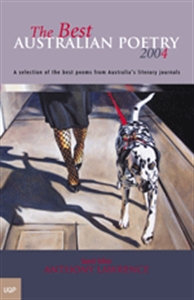
The Best Australian Poetry 2004 is the second of our projected annual surveys of contemporary Australian poetry published in literary journals and newspapers. Guest Editor Anthony Lawrence has established himself as one of Australia’s premier poets with a passionate and distinctive voice celebrated for its lush undulating movement, kaleidoscopic vision, and musical complexity.

Guest Editor: Anthony LawrenceGuest editor: Anthony Lawrence
Series editors: Bronwyn Lea and Martin Duwell

The Best Australian Poetry 2004 is the second of our projected annual surveys of contemporary Australian poetry published in literary journals and newspapers. We are encouraged by the over-whelming reception of the inaugural edition, The Best Australian Poetry 2003, (pre-sales made necessary a second reprint before the book was officially released) and this has given us confidence in the future of the series. Already we can see the benefits of a policy of engaging a different Guest Editor each year — this year, poet and author Anthony Lawrence — in that this selection feels radically different to last year’s. Rather than attempting a magisterial overview, we have always felt that the varied perspectives of changing Guest Editors will make, in the long run, for a rich and more accurate portrait of what is happening in poetry in Australia. At the practical level, this second edition has enabled us to think more carefully about those matters of policy which seem commonsensical in the abstract but which, in practice, come down to irritatingly minute decisions. Matters of nationality for eligible poets comprise one set of thorny examples, as do the list of journals from which the poems will be selected. In both cases, we have reconsidered but decided to continue our policy of including only poems by Australian citizens and residents published in Australian print journals and newspapers. In the case of the former, we learned its stark consequences when Lawrence returned his selection of his ‘best forty poems’ which included a poem by a well-known American poet who had somehow slipped through our filter: jettisoning the poem and requesting a replacement was a decision made not without considerable pain. In the case of the latter, we felt our decision was a bit harsh on journals such as Antipodes — the journal of the American Association for Australian Literary Studies — which has, for a number of years now, done a magnificent job of bringing Australian literature into the North American ambit and which, at the same time, continues to publish a number of fine Australian poems in each issue. But as well as celebrating Australian poets and poetry, we had decided at the outset to celebrate those journals and newspapers which, in the difficult climate of Australian culture with its attendant problems of lack of financial resources and lack of broad community support, nevertheless continue with a commitment to the poetry of Australia.

In a year in which Australia went to war, albeit as a small component of the ‘Coalition of the Willing,’ it is perhaps not surprising that one of the issues raised during 2003 involved poetry’s commitment to the public sphere. The positions of poets, as always, covered a span. At one end is an essential, though sometimes despairing, quietism inevitably invoking Auden’s ‘poetry makes nothing happen: it survives / in the valley of its making,’ though perhaps missing Auden’s point that, although the overarching cultural and physical conditions do not change (Ireland remains mad and its weather remains terrible), poetry’s survival as ‘a way of happening, a mouth’ is itself a cause for hope. At the other end is a belief in poetry’s capacity to be at least a component of protest. In March 2003, a collection of poems by 119 Australian poets was delivered to Australia’s Prime Minister as part of an international Day of Poetry Against the War. The poets included ten associated with this year’s Best Australian Poetry anthology: Robert Adamson, Adam Aitken, Judith Beveridge, Peter Boyle, MTC Cronin, Anthony Lawrence, Emma Lew, Les Murray, Thomas Shapcott and Chris Wallace-Crabbe. Speaking on behalf of Australian poets against the war, Alison Croggon’s comment that the collection was a ‘flotilla of poems which matches [Australia’s] military presence in the Middle-East — small, but symbolically significant’ perhaps strikes the right note for poetry in its engagement with the world’s macro-events: ambitious but realistic.

It is sad to have to record, in this introduction to our second volume, the passing of one of the contributors to the first volume. Norman Talbot, who died in January 2004, was a fine, if underrated, poet and a thoroughly distinctive voice in Australian poetry. His first two books, Poems for a Female Universe (1968) and its whimsically named sequel, Son of a Female Universe (1971), contain poems that one remembers fondly after more than thirty years. Talbot’s prize-winning poem sequence, ‘Seven New South Wales Sonnet-Forms,’ is included in this volume, and it was our sad task to inform Lawrence who, tucked away in Hobart, had not heard news of Talbot’s passing but had nonetheless selected this poem on merit. Another passing of importance was that of Clem Christesen, a Brisbane poet and prose writer who began Meanjin Papers as a small magazine in late 1940 in Brisbane. After the war the journal moved to Melbourne, contracted its name to Meanjin, and established itself as Australian premier cultural journal in the post-war period.

As we’ve stated, one of the many aims of this series is to celebrate those journals, such as Meanjin and the new and impressive literary journal Salt-lick Quarterly, which continue to publish quality Australian poems, as well as to celebrate those editors who devote immense stretches of time and infinite energies to produce quality magazines. On a more coercive (though suitably muted) note, we hope that the series will also encourage poets to renew contact with these journals. While emerging poets derive immense support and confidence from publication in small magazines, established poets sometimes withdraw while preparing book-length manuscripts and contribute poems to magazines not as a matter of course, but only when asked. There is a certain irony in the fact that the Guest Editor of this volume did not appear in the inaugural issue, having published no poems in literary journals in 2002. While he did publish poems in journals in 2003 — perhaps inspired by this series? — we are grateful that he agreed to forego possible inclusion in The Best Australian Poetry 2004 and agreed to be its Guest Editor instead.

In a series of books, beginning with Dreaming in Stone (UQP, 1989) and now his most recent The Sleep of a Learning Man (Giramondo, 2004), Lawrence has established himself as one of Australia’s premier poets with a passionate and distinctive voice celebrated for its lush undulating movement, kaleidoscopic vision, and musical complexity. Lawrence’s poems and collections have won just about every prestigious poetry prize in Australia, including the Newcastle Poetry Prize (1997) and the Josephine Ulrick Poetry Prize (2001), as well as the Judith Wright Calanthe Poetry Prize (1991) and the New South Wales Premier’s Kenneth Slessor Prize for Poetry (1996). His poetry is rightly admired by many for its exploration of the immense drama of the Australian landscape, capturing not only the harshness of rural life but also meditating on the intricate and startling details of native birds, fish, and animals. But Lawrence is also intensely interested in the human animal and, in this aspect, his poems are often set into continual motion, converging and dispersing in a kinetically-charged human drama. It’s perhaps not surprising, then, that his selection here contains not only many poems about animals — dogs, horses, birds, bats, fish, and the platypus — but also many poems about love — romantic and familial — with all the violence and tenderness that these relationships incite and demand. There are poems too that explore the human at home in the body — a body that oozes, bleeds, and aches, but one that also loves, desires, and heals — as well as poems that are intensely interested in language, another of Lawrence’s own interests, and in how poetry might effectively address the cerebral and political dimensions of creative life. Lawrence’s selection is not only intelligent but also dramatic and flamboyant, revealing an unquenchable and quirky passion for life immersed in the magnificent clutter of lived reality.

During the proofing of this introduction we received word of the death of Bruce Beaver at the age of seventy-six. He was one of Australia’s greatest poets, an indefatigable writer and a great celebrator and lamenter. His most admired book was his fourth, Letters to Live Poets, published in 1969, but the volumes that followed it — Lauds and Plaints and Odes and Days — as well as the volumes that followed these books, are really major contributions to Australian poetry. Beaver showed Australian poets how it was possible to be wide-ranging and international in one’s reading and one’s concerns while writing in a way that seems absolutely Australian. He was always concerned with poets and his two totemic poets were Po Chu-I (whose unstoppable ability to turn life into poetry was something he admired) and Rilke. One of the best poems in Beaver’s first book, Under the Bridge (1961) is ‘Remembering Golden Bells…and Po Chu-I,’ which retells the story of the Chinese poet’s loss of his little daughter, Golden Bells. It seems fitting that in one of his final poems — from his postumous collection The Long Game and Other Poems (UQP, 2005) — Beaver recalls his Chinese mentor:

Late Afternoon

A last radiance of sunlight
illuminates an empty chair, an empty couch.
Visitors are few and when they come
I don’t wish them away
but do hope they won’t stay too long
for my closest friends are books and blank paper.
My fingers itch for the pen and later
my eyes focus on the pages of others.
It’s understandable: I’m in my seventies
and though the days moving into summers
are growing longer, my years are growing shorter.
Like Po Chu-I, I have been away from the Capital
a long time; though I have not lost any children
I watch the faces of acquaintances
and see in them a lost child here and there.
Surely parenthood is a vocation
like poetry, unlike poetry.

Foreword: The Best Australian Poetry 2003

The Best Australian Poetry 2003, the first in what we hope will be a long and vibrant series, is a selection of 40 of the best poems published in Australian literary journals and newspapers in the preceding year. Martin Duwell brings to this volume his experience that comes from 35 years in poetry publishing and criticism, as well as a passion for poetry that rivals any poet’s.

Guest Editor: Martin DuwellForeword: Bronwyn Lea
Guest editor: Martin Duwell
Series editors: Bronwyn Lea and Martin Duwell

The Best Australian Poetry 2003, the first in what we hope will be a long and vibrant series, is a selection of 40 of the best poems published in Australian literary journals and newspapers in the preceding year. Poetry in Australia is thriving. According to my somewhat shaky mathematics, in 2002 there were exactly 100 volumes of poetry published (that’s one poetry book for every five novels) and 27 themed anthologies containing at least some poetry. Australian newspapers published almost 400 new poems (as well as reprinting some classics) and Australian literary journals published close to 1,800 poems. As the general editors for The Best Australian Poetry series, Martin Duwell and I hope that this anthology will direct readers to the poetry collections of the poets they enjoyed in this and future issues, as well as point to the literary journals that continue to publish high-quality poems.

We regret that we have not included poetry from Australian internet journals in this anthology. The decision to limit sources to the print media was based, for this year at least, on logistics, but it is possible that this might change in the future. In the meantime, I’d like to point to some websites worth looking at, including Cordite, Divan, Stylus, and John Tranter’s hugely popular Jacket, which brings into conversation poets and critics from around the world. Taking a different tack, Coral Hull’s Thylazine continues to make a case for poetry and activism, as well as provide an Australian poet directory — to which I am indebted in the course of tracking down some of the poets included in this anthology. And then there’s Jayne Fenton Keane’s Slamming the Sonnet website, which makes the most of web technology by using audio and video files to flesh out poetry and breath a little life into the critically-declared “dead” author. Last time I logged on, Queensland poet Sam Wagan Watson held his own in a cyberslam against Yeats, Plath, and Bukowski.

2002, like any year, was a time of things living and things dying. Most significantly it saw the passing of three major poets, Dorothy Hewett, Ron Simpson, and Gary Catalano. The former was always a flamboyant, larger than life figure in Australian poetry but one who showed that poetry could still embrace the large questions of public and private lives. Simpson and Catalano were quieter writers and it might be said they belong to the tradition that imported some of the values of the visual arts — especially a concentration on line — into our poetry. At the institutional level, Robert Adamson and Juno Geme’s Paperbark Press shut its doors after 17 years of publishing some of Australia’s finest poets. Shortly after, Ivor Indyk announced a new arm to his publishing house: the publication of literary works by individual authors under the Giramondo book imprint. Another birth worth noting is Ron Pretty’s revival of Poetry Australia, in this incarnation entitled Blue Dog: Australian Poetry. In Pretty’s editorial for the inaugural issue, he backs up contributing essayist Michael Sharkey’s assessment of the impoverished state of poetry criticism in Australia and puts out a call for “thoughtful pieces written about contemporary Australian poets and their work”. Which seems a good idea.

Given this discussion, then, it is no accident that we have decided to kick off the inaugural issue of The Best Australian Poetry with a guest editor who is not a poet, but a poetry critic. Martin Duwell brings to this volume his experience that comes from 35 years in poetry publishing and criticism, as well as a passion for poetry that rivals any poet’s. Presented with the task of selecting only 40 poems from over 2,000 possible poems, Duwell has created (without much fuss) a terrific collection of high-quality poems that is sure to impress dedicated readers of Australian poetry and newcomers alike. Duwell possesses that rare ability Sharkey calls for in his essay “Reviewing Now”: “the ability of read widely, without prejudice”, which struck me immediately when I read his compilation and noted the diversity of form, voice, style, and subject matter. Duwell has a critic’s eye for quality, but also an anthologist’s sensitivity as to how individual poems converse — how they confront, contradict, affirm, and question one another.

Which brings me to another matter. I began writing this Foreword — then stopped for a long while — in October 2002. It was the time of the bombings in Bali. Which is to say, I wrote this within history, which is to date it. Many poems were born of this time, and like the thousands of 911 poems before them, Bali-bombing poems whizzed around the internet and clogged open-mic readings across the country. How many of these poems will survive remains to be seen — not many occasional poems do — but their existence illustrates Denise Levertov’s assertion (quoting Heidegger interpreting Hölderlin) that to be human is to “be a conversation”. Many it seems turn to the poem when their human need for dialogue, “in concretions that are audible to others”, overwhelms them.

Elsewhere with equipoise

Alan Gould reviews Flight Animals (UQP, 2001) by Bronwyn Lea. This extract first appeared in Quadrant Vol XLVII (Oct 2003): 68-74.

by alan gould

The quality in the art of Bronwyn Lea that I would most like to highlight is what I will call its equipoise. It is a quality to be found throughout this, her exquisitely well-wrought first volume, Flight Animals.

Bronwyn Lea’s poems argue, and because they do this with such intentness and unforeseeableness, it is difficult to quote from them piecemeal. But let me try to illustrate what I mean by equipoise in ‘Antipodes’:

In this lifetime, antipodes must be
my word, my home or anyone else’s.
Anyone who lives at opposites or knows
what it is to be contrary, to deviate. Like
disparate continents. Like the holding of
Europe and Australia in your blood.
This, I find, is a feat. And I recognise, as I age
that my apogees are elongating,
my reversals are rising like the swollen
belly of a frog storing water in its sleep.

Into the discourse are brought a friend, perplexed, like the speaker, by the ground upon which one can give and receive love, and a man, a lover, with ‘sand-heavy eyes’. The poem argues in favour of loving the thing-in-time rather than the Ding an sich, and how the disparity of claims made upon our nature can be reconciled when this view is taken. Her premisses are clear, her leaps of logic finely discerning, her images vivid, and only towards the end do we learn the poem has a dramatic context. For it is being meditated in the immediate aftermath of lovemaking, looking out on a particular view:

…Then just now, lying
in the low light of afternoon, I saw
it is the movement more than the man
that I love, the movement in and out
of me, framing the sweet falling
of lilac pollen, falling soft upon his back,
my tongue.

So, the poem’s equipoise lies in the balancing of its forces, abstract proposition and personal feeling, worldwide tectonics with the intimacy of two human bodies alone together, argument with confiding, a casualness in the diction with an incisive control of the intellectual substance, an audacity in the turns of discourse with a sureness of how the whole should resolve itself. In this poem, and throughout the volume, the close attention this poet requires us to bring to her work is rewarded by the sense of an entirely new arrangement of thought and feeling having been made.

Deeply Bronwyn Lea has absorbed the example of Wallace Stevens. Her doctoral thesis was entitled ‘To Dwell in Possibility’ and like the American poet, the poems in Flight Animals make the case for the status of the imagination. Imagination creates, not likenesses of being, but new states of being. The poem is ‘the cry of its occasion, part of the res itself and not about it’.

The pace is characteristically calm, the emotion complex, the eye attentive for just the image that will illumine her reasoning without overstatement, that will catch the humour, create the tact, the fine connections of a very singular sensibility.

To take one poem from this book as I have done is useful in describing the intellectual and emotional finesse in Bronwyn Lea’s work, but it does not do justice to her range. Flight Animals abounds in poems achieved in ways never quite expected. The twenty-six proverbial distinctions in ‘Catalogue of People’ mingle aphoristic sagesse with a humour that subverts the endemic smugness of distinctions. Her ‘Seven Feet & Where They’re From’ is as much a gentle pastiche of John Forbes’ ‘Four Heads & How to Do Them’ as a means of entering attitudes of mind, historical, ethnographic, etymological. Entailed in this sequence – ‘The Chinese Foot’ particularly – is a gift for story-telling that is elegant, delicate, purposive. In her tanka sequence, ‘A Rush of Butterflies’, she places a series of deft images to describe the process of sorrowing after lost love:

By my foot, a skink
Fixes an eye on me – more
Devoted than you.

My shovel splits an earth worm –
I watch the two ends wriggle.

But her qualities are more typically integrated within the single utterance than incidental to several poems. Often her preoccupation is with mutability. In poems like ‘Deepcreek Hotsprings’, ‘Orthograde’, ‘Woman Holding a Vase’, the pace is characteristically calm, the emotion complex, the eye attentive for just the image that will illumine her reasoning without overstatement, that will catch the humour, create the tact, the fine connections of a very singular sensibility.

Alan Gould reviews Flight Animals (UQP, 2001) by Bronwyn Lea. This extract first appeared in Quadrant Volume XLVII (Oct 2003): 68-74.